
Blog
What Does CE AA Rated Mean on a Motorcycle Leather Jacket?

You are on a product page. The jacket looks right — the leather is thick, the stitching is double-sewn, and the price reflects quality. Then you notice it: CE AA. Is that the armor rating? A certification tier? Something to do with the CE mark on the back protector you just bought separately?
This confusion is almost universal, and it stems from one root cause: motorcycle jackets carry two completely separate CE systems, and most product listings treat them as a single rating.
The first system — EN 1621-1 / EN 1621-2 — applies specifically to the armor inserts: the shoulder pads, elbow pads, and back protector fitted inside the jacket. These are rated at Level 1 or Level 2.
The second system — EN 17092:2020 — applies to the jacket shell itself: the fabric, the seams, and the construction that protect your skin if you make contact with tarmac. This standard uses a class system: AAA, AA, A, B, and C.
CE AA on a leather jacket refers to the garment class under EN 17092, not the armor. By the end of this guide, you will know exactly what that class means, what tests the jacket passed to earn it, and why leather construction naturally achieves the higher ratings in that scale.
MotoGP Gears sources exclusively from manufacturers who supply full certification documentation. This article reflects the technical knowledge embedded in that sourcing process.
The Two CE Systems on Motorcycle Jackets — Why Buyers Get Confused
The European PPE Regulation (EU 2016/425) governs all personal protective equipment sold in the EU and UK markets, and motorcycle clothing falls within its scope. Within that regulatory framework, two distinct product standards apply to a typical leather jacket, and both produce a CE marking — which is precisely where the confusion originates.
CE Level 1 and Level 2 — This Is for the Armor Inserts, Not the Jacket Shell
EN 1621-1 specifies the test method and performance thresholds for limb impact protectors — the shoulder and elbow armor you insert or remove from the jacket pockets. EN 1621-2 governs back protectors, which may sit in a dedicated armor insert pocket at the rear of the jacket.
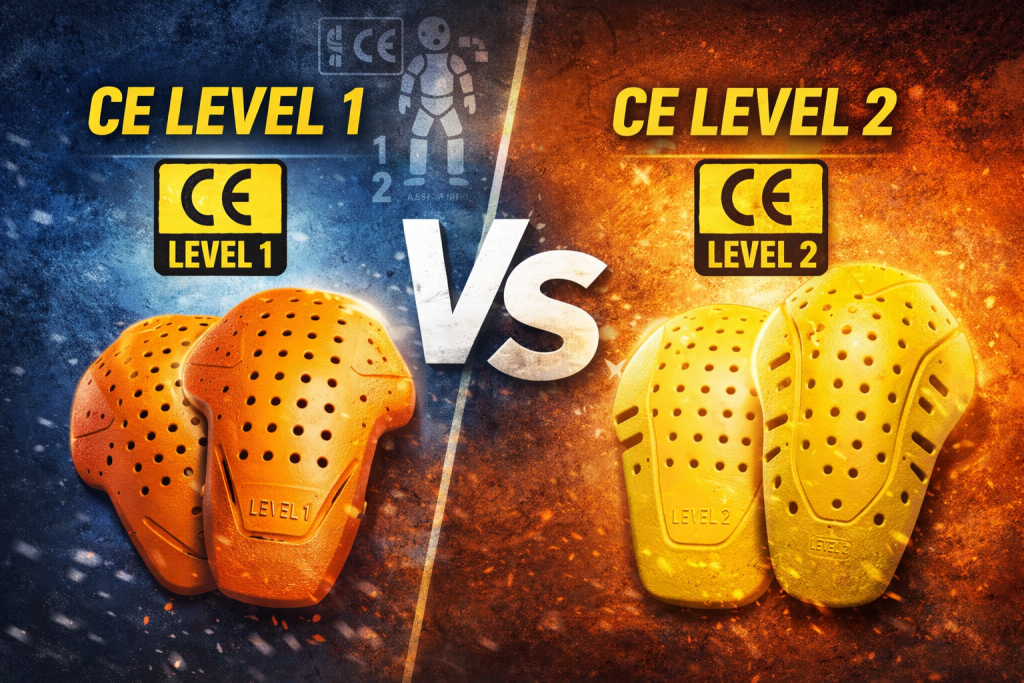
Level 1 armor must transmit no more than 35 kN mean force during the impact test. Level 2 armor reduces that threshold to 20 kN. Both are meaningful improvements over an unprotected joint, but the rating tells you nothing about the jacket fabric surrounding that armor.
A jacket can be sold with Level 1 armor inserts while simultaneously holding a CE AA garment classification. The two ratings coexist independently.
EN 17092 Classes — This Is for the Jacket Fabric and Construction
EN 17092:2020 is the current standard for protective clothing for motorcycle riders in Europe. It defines five classes — AAA, AA, A, B, and C — based on measured performance across abrasion resistance, seam burst strength, tensile strength, and tear resistance. These tests evaluate what happens to the jacket material when it contacts road surface at speed.
Here is the distinction in practical terms:
| What You See on a Label | What It Actually Rates |
| CE Level 1 / Level 2 | The impact protector insert (armor) only |
| CE AA (or AAA, A, B, C) | The jacket shell: fabric, seams, construction |
| CE marked jacket | The overall garment has been assessed under EN 17092 |
| ‘CE Certified’ (no standard listed) | Non-compliant — likely not formally tested to any standard |
EN 17092 Explained: The Five Jacket Protection Classes (AAA to C)
EN 17092:2020 divides motorcycle garments into five performance classes. Each class is defined by minimum pass thresholds across four mechanical tests. Higher classes require more demanding performance in Zone 1 — the primary impact areas, including shoulders, elbows, and the back.

Class AAA — Maximum Abrasion, Burst, and Seam Resistance
AAA is the highest classification under EN 17092 and represents the performance required for track-specification and racing garments. The abrasion test requires Zone 1 material to withstand at least 7.5 seconds of contact using the Darmstadt drum test method before perforation or puncture occurs. Zone 2 materials must achieve at least 2.5 seconds.
Seam burst strength at AAA must exceed 270 N for Zone 1 seams. The standard also applies tensile and tear resistance thresholds consistent with the forces encountered in a high-speed slide. Most one-piece racing leathers and premium two-piece suits target this classification.
Class AA — Second Highest; Sports and Premium Street Jackets
CE AA is the classification most commonly found on quality genuine leather motorcycle jackets intended for road use. Zone 1 requires a minimum of 4 seconds in the abrasion test; Zone 2 requires 1.5 seconds. Seam burst strength must exceed 220 N in Zone 1.
This class represents a meaningful real-world protection level. A 4-second abrasion threshold corresponds broadly to the slide distance an average rider might experience in a low-to-mid-speed impact — though EN 17092 itself makes no direct claims about speed equivalence. The majority of genuine cowhide leather jackets from reputable manufacturers fall into this class or above.
Class A — Entry-Level Protective Garment
Class A requires Zone 1 abrasion resistance of at least 1.5 seconds and Zone 2 of at least 1 second. Seam burst strength threshold is 180 N. This classification is legally sufficient for road riding in most EU and UK markets and represents the minimum level at which a garment may claim meaningful structural protection.
Many urban commuter jackets, lighter textile constructions, and entry-level leather garments target Class A. It provides a defined baseline, but the gap between A and AA is significant when measured in abrasion seconds.
Class B — Protector-Only Certification
Class B garments are assessed only for their ability to accommodate and retain certified impact protectors. There is no abrasion resistance requirement on the garment material itself. This class is typically applied to over-trousers, casual riding jeans, or garments where the protective function is entirely delegated to the armor.
Class C — Visibility Garments
Class C applies to high-visibility garments — vests, tabards, and similar items worn for conspicuity rather than impact protection. No structural or abrasion requirement applies. A Class C garment does not protect in a slide.
EN 17092 Class Performance Summary:
| Class | Zone 1 Abrasion (min.) | Zone 2 Abrasion (min.) | Zone 1 Seam Burst (min.) | Typical Application |
| AAA | 7.5 seconds | 2.5 seconds | 270 N | Race track, circuit riding |
| AA | 4.0 seconds | 1.5 seconds | 220 N | Sports road, premium touring |
| A | 1.5 seconds | 1.0 second | 180 N | Urban commuting, general road |
| B | No requirement | No requirement | No requirement | Protector-retention garments |
| C | No requirement | No requirement | No requirement | High-visibility only |
What EN 17092 Tests Actually Measure — and What They Don’t
Understanding the test methodology clarifies why class thresholds matter and where the standard’s scope ends.
Abrasion Resistance — The Darmstadt Drum Test
The primary abrasion test used in EN 17092 is based on the Darmstadt drum method. A sample of jacket material is mounted on a rotating drum lined with standardised abrasive material, and the time to first perforation is recorded. The drum rotates at a controlled speed under controlled pressure, producing repeatable results that allow cross-material comparison.
The test is not a speed simulation. It does not replicate the exact dynamics of a tarmac slide, which involve variable speed decay, contact angle, and surface texture. What it does provide is a standardised relative measure of abrasion resistance that allows engineers and certification bodies to rank materials consistently.
In practical terms: a material that perforates in 1.2 seconds on the drum provides measurably less protection than one that survives 5 seconds. The test result reflects the fibrous integrity of the material under sustained abrasive load — which is directly relevant to road contact in a fall.
Seam Burst and Tear Resistance — Stitching as a Primary Failure Point
Garment seams are a well-documented failure mechanism in crash injuries. When a jacket separates at the seam during a slide, the skin beneath is directly exposed to the abrasive surface regardless of the fabric rating. EN 17092 includes seam burst strength and tear resistance tests for this reason.
Seam burst strength is measured using a device that applies increasing radial force to a fabric sample until the seam fails. The result, measured in newtons, defines whether the garment holds together under the lateral forces of a slide. High seam burst strength — achieved through reinforced stitching, doubled seams, or structural tape — is as important as the fabric rating itself.
What EN 17092 Does Not Test
EN 17092 is a mechanical protection standard. It does not assess impact absorption — that function belongs to the impact protector, tested under EN 1621-1 or EN 1621-2. The standard also does not evaluate waterproofing, thermal insulation, or breathability.
This distinction matters for buyers comparing textile jackets with integrated waterproof membranes to leather garments. A textile jacket may perform better in wet conditions while achieving a lower EN 17092 class. The standards are testing different things.
Zone mapping under EN 17092 identifies Zone 1 as the primary impact surfaces — the areas most likely to contact the ground first — and Zone 2 as secondary zones. Zone 1 always carries higher performance thresholds. Where exactly these zones fall is defined in the standard’s garment diagrams and varies slightly between jacket and trouser garments.
Why Genuine Leather Naturally Achieves CE AA and AAA Ratings
The relationship between leather and the upper EN 17092 classes is not coincidental. It follows from the material properties of leather at a structural level.
Material Science: Leather’s Fibrous Collagen Structure
Animal hide is composed of densely interlocked collagen fibres arranged in a three-dimensional network across the grain and corium layers. This structure distributes abrasive force laterally across a large area rather than concentrating it at a single point. As the surface is abraded, successive layers of collagen resist the load — the material does not fail suddenly or catastrophically but degrades progressively.
Woven synthetic textiles — even high-tenacity aramid or UHMWPE constructions — present a fundamentally different abrasion mechanic. The warp and weft fibres of a woven fabric concentrate abrasive load at each fibre crossing. Once a thread breaks, adjacent threads carry increased load and fail in sequence. This cascade failure mechanism is why woven textiles, regardless of individual fibre strength, typically reach perforation faster than equivalent-weight leather under drum testing.
Cowhide vs Kangaroo Leather — Abrasion Time and Thickness Trade-offs
Genuine cowhide leather at 1.2 to 1.4 mm thickness is the industry standard for CE AA compliant motorcycle jackets. At this thickness, quality full-grain cowhide typically achieves 4 to 6 seconds in Zone 1 abrasion testing — clearing the AA threshold with meaningful margin.
Kangaroo leather is the premium alternative used in racing leathers. Kangaroo hide produces a denser collagen matrix at lower thickness, allowing CE AAA performance at 0.8 to 1.0 mm. The weight reduction is significant for circuit use, though kangaroo leather is more expensive and requires more careful sourcing.
The thickness trade-off is real: thicker cowhide at 1.4 mm or above can approach AAA thresholds, but the resulting garment is heavier and less flexible. Most manufacturers optimise at 1.2 to 1.3 mm for the AA class, accepting the weight-protection balance that suits road riding.
Why Textile Jackets Often Cap at CE A
High-performance textile motorcycle jackets use constructions that include aramid reinforcement panels, ballistic nylon layers, or combinations of woven fibres engineered specifically for abrasion resistance. Some quality textile constructions do achieve CE AA. However, the majority of mid-range textile jackets — and virtually all casual-style jackets — achieve CE A or do not carry a garment-level EN 17092 rating at all.
The limitation is material mechanics. A woven structure that is light enough and flexible enough for all-day riding typically cannot sustain abrasive load for the 4 seconds required at Zone 1 for the AA class. Manufacturers targeting CE AA in textile typically achieve it with significant added bulk — defeating some of the textile format’s utility advantage.
This is the core material argument for a genuine leather jacket when protection is the primary consideration. The abrasion performance that leather delivers at moderate weight is a product of its structure, not its thickness alone. MotoGP Gears’ genuine leather category reflects this — each jacket listed is verified to its EN 17092 class before it is offered for sale.
How to Read the CE Label on Your Jacket — A Practical Field Guide
EN 17092 requires that certified garments carry a permanent label with specific information. Knowing how to read this label allows you to verify any jacket’s certification — whether you already own it or are considering a purchase.
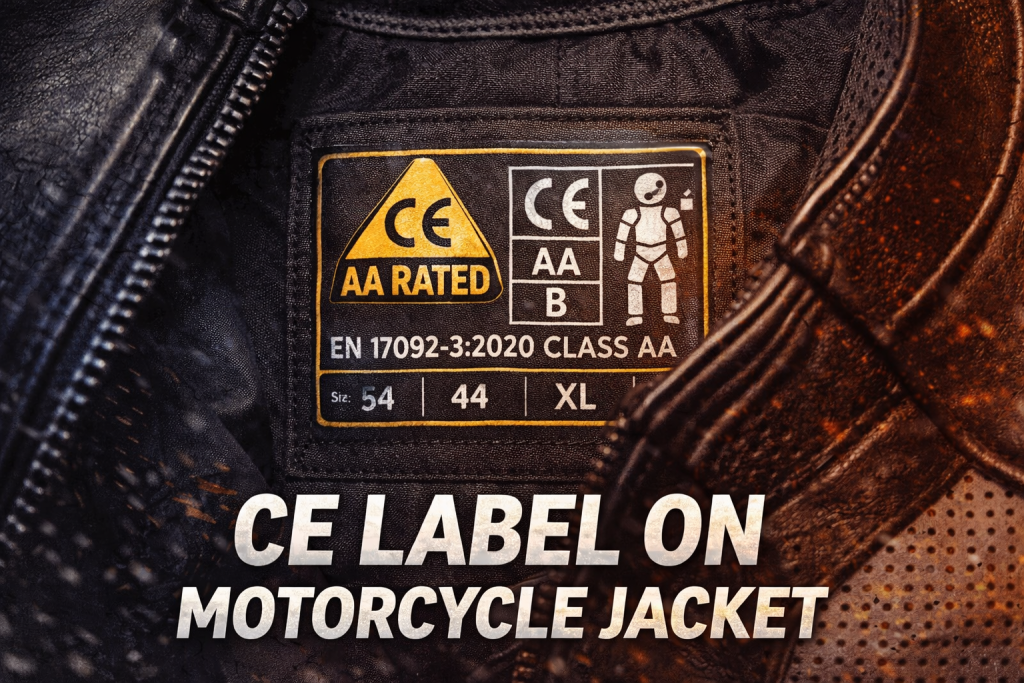
Locating the Label
The CE garment certification label is typically sewn into the inner seam of the jacket — most commonly at the collar, the side seam, or attached to the main care label. On some garments it appears as a separate hang tag. The label must be durable, legible, and permanently attached.
Armor labels are separate. Each insert — shoulder, elbow, back protector — carries its own EN 1621 label, usually printed on the foam or moulded surface of the protector itself. Do not confuse the two label sets.
Decoding the Garment Label
A compliant EN 17092 label must include:
- The EN 17092:2020 standard reference
- The class designation: AAA, AA, A, B, or C
- The CE marking, followed by the four-digit number of the Notified Body that conducted the conformity assessment
- The manufacturer’s name and address
- The year of manufacture or the date of conformity assessment
- The garment size and relevant sizing standard
The Notified Body number is the element that verifies independent testing. A CE marking without a four-digit Notified Body number is a self-declaration and does not confirm third-party conformity assessment.
Red Flag: Vague CE Claims with No Standard Listed
‘CE Certified’ printed on a hang tag without any standard reference, class designation, or Notified Body number is a non-compliant label. It indicates either that the garment was not formally tested to EN 17092, or that the labelling does not meet the minimum disclosure requirements of the European PPE Regulation.
This is not a minor administrative issue. A jacket sold as ‘CE certified’ without a verifiable class designation offers the buyer no information about what level of protection was actually assessed. When evaluating a jacket, look for the standard number and the class in the same label.
CE AA vs CE AAA — Which Class Do You Actually Need?
EN 17092 class selection should follow riding context. The protection differential between AA and AAA is real, but it does not automatically make AAA the correct choice for every rider.
Track and Circuit Riding — AAA is the Minimum Sensible Choice
At closed-circuit speeds, slide distances and surface contact times are substantially longer than in typical road incidents. Many circuit venues and track day operators specify AAA-rated garments as a condition of entry, particularly for unsupervised track sessions. A CE AAA one-piece suit or two-piece combination provides the abrasion time margin that circuit speeds demand.
For circuit use, a CE AA jacket, while a quality garment, does not provide the abrasion duration that the top class offers. If you ride on track with any regularity, AAA should be treated as the baseline.
Sports and Performance Road Riding — CE AA is the Standard
For road use, including B-road and motorway riding at legal speeds, CE AA represents the appropriate balance of protection, garment weight, and flexibility. The abrasion resistance at this class is designed for the impact velocities and contact durations realistic in road accidents. A genuine leather jacket at CE AA provides a meaningful and verified level of protection that significantly exceeds an unrated or CE A garment.
Urban Commuting and Touring — CE A is Sufficient, AA Is Better
CE A meets the legal minimum in most EU and UK jurisdictions for road use. For low-speed urban commuting, the risk profile is different from motorway or sports riding, and CE A provides a tested protection level. However, for riders who spend significant time at higher speeds — even during touring — the upgrade to CE AA is worthwhile and the cost premium in genuine leather is modest.
Use Case Selection Guide:
| Riding Type | Recommended Class | Preferred Leather |
| Circuit / Track Day | AAA | Kangaroo or thick cowhide |
| Sports Road / B-roads | AA | Genuine cowhide (1.2–1.4mm) |
| Motorway Touring | AA | Genuine cowhide |
| Urban Commuting | A minimum, AA preferred | Cowhide or quality textile |
| Casual / Low Speed Only | A | Any EN 17092 certified material |
MotoGP Gears’ CE Compliance Approach — How We Verify Every Jacket
Listing a jacket as CE AA requires more than accepting a manufacturer’s product description. MotoGP Gears’ sourcing process includes direct verification of EN 17092 certification before any garment is added to the catalogue.
For each jacket, we request the test report from the issuing Notified Body, or confirmation of the report reference number that can be cross-checked with the certification body’s register. Manufacturer self-declarations without accompanying test documentation are not accepted as sufficient for listing.
Where possible, sample garments are physically inspected prior to stock commitment. This inspection includes seam examination — checking stitch density, thread specification, and reinforcement at Zone 1 boundaries — as well as label compliance. A label that does not include the standard reference, class, and Notified Body number flags a compliance issue regardless of what the manufacturer claims.
Members of our team ride. That context informs how we assess garments beyond the label. Fit, flexibility at riding position, armor pocket retention, and wearability are evaluated alongside the documentation — because a jacket that a rider will not wear because it is uncomfortable provides no protection at all.
MotoGP Gears does not list garments where the certification documentation cannot be confirmed. If a jacket falls outside that standard, it is not stocked, regardless of its price point or the brand behind it. We use safety features for best riding.
Frequently Asked Questions — CE Ratings on Leather Jackets
Is CE AA Rating Mandatory for Road Riding in the UK or EU?
No. EN 17092 establishes performance classes but does not specify which class is legally required for road use in most jurisdictions. In the UK, motorcycle clothing is not legally mandated to carry any specific CE class. EU member states may have local road traffic regulations, but EN 17092 certification is generally not a legal riding requirement in the same way that helmet standards are.
CE AA is not a legal threshold — it is a performance benchmark. Riding without a certified garment is legally permissible in most markets. The class system exists to give buyers verifiable comparative data, not to function as a mandatory licence condition.
Can a CE AA Jacket Replace Full Race Leathers on a Track Day?
This depends entirely on the circuit operator’s rules, which vary. Some track day operators accept CE AA road jackets; others specify AAA and may require a one-piece suit for certain sessions. Before attending a track day, confirm the garment specification with the organiser directly.
From a protection perspective, a CE AA jacket is not equivalent to a AAA race suit at circuit speeds. The abrasion time margins are different, and most dedicated race leathers include construction features — reinforced panels, stretch inserts, aerodynamic back humps — not present in road jackets.
Does Washing or Ageing Reduce a Leather Jacket’s CE Rating?
EN 17092 testing is performed on new garments. The standard does not specify a durability or service life requirement. In practice, genuine leather that is properly conditioned and maintained retains its structural integrity for many years. However, leather that has dried, cracked, or been saturated and improperly dried may lose abrasion resistance.
Machine washing leather is likely to degrade the collagen structure and any protective coatings. If a leather jacket is washed incorrectly or allowed to degrade significantly, its real-world abrasion performance may fall below the class at which it was certified. Regular conditioning with appropriate leather care products is the most effective way to preserve material integrity.
What Is the Difference Between CE Approved and CE Certified?
‘CE Certified’ has a specific meaning when applied accurately: it indicates that a garment has been assessed by a Notified Body against an applicable harmonised standard, and the CE marking has been affixed in compliance with the relevant EU Regulation. The label must display the Notified Body number.
‘CE Approved’ is not a defined regulatory term. It is marketing language. When a seller describes a jacket as CE approved without referencing a standard, a class, or a Notified Body number, that description has no verifiable regulatory content. This distinction is important: a jacket bearing a CE mark without the supporting label elements required by EN 17092 may not have passed any formal conformity assessment.
Is CE AA Better Than Level 1 Armor?
CE AA and CE Level 1 measure completely different things and cannot be compared on the same scale. CE AA (EN 17092) rates the jacket shell’s abrasion resistance and structural integrity. CE Level 1 (EN 1621-1) rates the armor insert’s ability to absorb and attenuate impact energy.
A jacket can be CE AA with Level 1 armor, CE AA with Level 2 armor, or CE A with Level 2 armor. The class and the armor level are independent specifications. For full protective coverage, both matter: the garment class determines what the shell does if you slide, and the armor level determines what the insert does if you impact an object or surface directly.
Published by MotoGP Gears | Technical Reference: EN 17092:2020, EN 1621-1:2012, EN 1621-2:2014 | European PPE Regulation (EU) 2016/425