
Blog
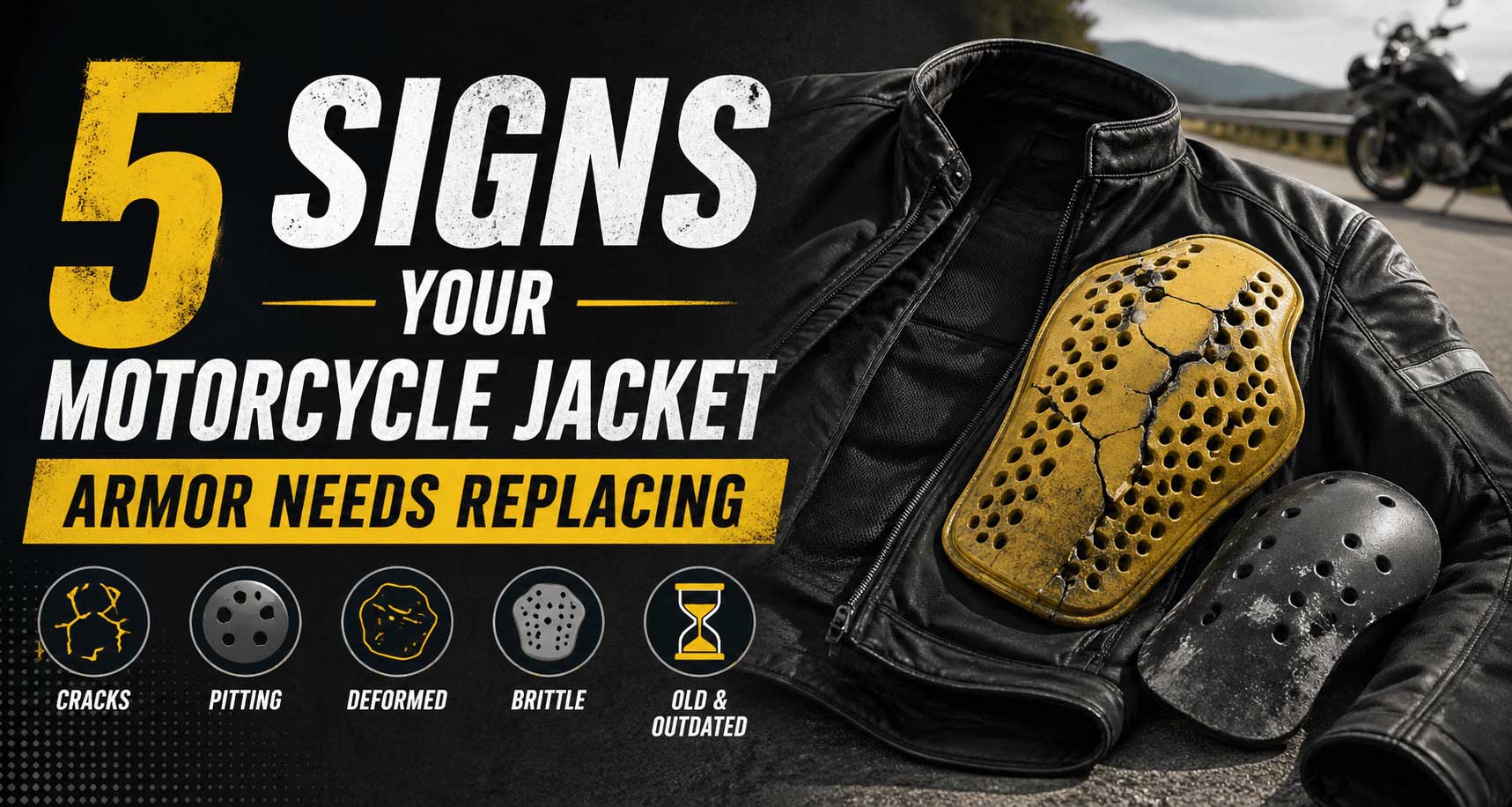
5 Signs Your Motorcycle Jacket Armor Needs Replacing

MotoGP Gears — Rider Safety Guide
By the MotoGP Gears Team·Updated 2025·8 min read
Your motorcycle jacket armor has a lifespan. Most riders never think about it — until after a crash.
Whether you’re a daily commuter on I-95 in New Jersey, a weekend canyon carver on the Angeles Crest Highway in California, or planning a full run of Route 66, the armor inside your jacket is doing a silent, invisible job. When it stops doing that job, there’s no warning light. No alert. Just less protection when you need it most.
We’ve fitted and tested CE-certified riding gear for years at MotoGP Gears. These are the five signs we tell every customer to watch for.
Why This Actually Matters in the U.S.
6,218Motorcyclist fatalities in the U.S. in 2022 (NHTSA)
20–70%Reduction in serious injury with CE-certified armor (peer-reviewed research)
The NHTSA reports motorcyclists are 24 times more likely to die per mile traveled than car occupants. On high-speed corridors like I-10 in Texas or the I-5 in the Pacific Northwest, the margin for error on degraded gear is zero.
Worn armor doesn’t just offer less protection — it may offer none at all in the zones it was designed to cover.
SIGN 1
Your Armor Has Been in a Crash — Even a Small One
A low-speed drop in a parking lot. A minor slide off the Tail of the Dragon (US-129) in Tennessee. A stationary tip-over on a gravel shoulder of US-50 in Nevada. Any contact between armor and hard ground counts.
Protective foam absorbs impact energy by permanently deforming at a micro-structural level. That deformation is invisible from the outside, but the armor’s energy-absorbing capacity has been spent. Hard-shell panels can fracture internally without showing a surface crack.
⚠ CE certification testing (EN 1621-1 / EN 1621-2) is conducted on new, unimpacted material. Once armor has absorbed a significant impact, its certified performance cannot be assumed for the next one.
Rule of thumb: If the armor made contact with the ground, replace it before your next ride. No exceptions.
My Take — MotoGP GearsI’ve seen riders bring in jackets after a lowside, insisting the armor looks fine. We flex-test every insert regardless. Three out of five times, there’s internal deformation that only shows up under pressure. Don’t trust what you can see — replace what took the hit.
SIGN 2
The Foam Has Hardened, Cracked, or Won’t Bounce Back
Pull the inserts out of your shoulder and elbow pockets. Flex them. Compress them. They should feel pliable and spring back immediately.
- Foam that stays compressed or recovers slowly — compromised density, reduced absorption
- Any surface cracking or crazing along flex lines — material has dried out
- Stiffness or brittleness around the edges — polymer breakdown from UV or cold storage
- Hard-shell panels that creak or crack when gently bent — structural integrity gone
This happens faster in high-UV states. If your jacket lives in an unshaded garage in Phoenix, Arizona or spends summers on the back of a bike crossing the Mojave Desert on I-40, degradation is accelerated compared to a rider storing gear in a cool, dark closet in Seattle.
My Take — MotoGP GearsThe riders who catch this the least are those who only ride in summer. Jacket sits in a hot garage from October to April — foam is baking the whole time. By spring, the armor looks identical but performs like cardboard. Flex-test your inserts every season, not just after crashes.
SIGN 3
The Armor No Longer Sits Over the Right Joints
Armor that has warped, shrunk, or shifted position is no longer protecting what it was designed to protect. A shoulder insert that has curled 2 cm out of alignment leaves your AC joint exposed. An elbow pad that rides high covers your forearm, not your olecranon.
Put your jacket on fully zipped. Look in a mirror and check:
- Shoulder armor — does it sit directly over the shoulder cap, not forward onto the upper arm?
- Elbow armor — does it cover the elbow joint when your arm is in the riding position?
- Back protector — does it run along the full length of your spine without gapping at the top or bottom?
- Chest insert (if fitted) — is it flat against the sternum, not riding up toward the collarbone?
If any insert doesn’t sit correctly in its pocket — especially on a riding-position check rather than a standing check — it needs replacing before your next highway stint, whether that’s the PCH in California or I-64 through the Appalachians in Virginia.
SIGN 4
Your Armor Is CE Level 1 — or Has No CE Label At All
CE Level 1 is not dangerous. But CE Level 2 transmits approximately 45% less peak force to your body on impact. That gap matters on any road where a slide can happen at speed.
CE Level 1 (EN 1621-1): Max 35 kN average transmitted force, no single reading above 50 kN.
CE Level 2 (EN 1621-1): Max 20 kN average, no single reading above 30 kN.
Check the sewn label on your insert. It must show the CE mark, the standard number, and the level (1 or 2). No label = no confirmed protection.
A lot of jacket armor sold in the U.S. before 2020 — especially budget imports — carries Level 1 certification under the old test protocol, which permitted even higher transmitted forces than today’s Level 1 threshold. If your jacket is more than five years old and you’ve never checked the labels, now is the time.
My Take — MotoGP GearsWe had a customer come in after a mid-speed slide on US-101 near San Francisco. Jacket was two years old, looked great. The elbow insert had no CE label — just a foam pad the manufacturer tossed in. She walked away, but it was luck, not gear. Always check the label before you ride in new gear.
SIGN 5
The Armor Is More Than 5 Years Old
Even if you’ve never crashed. Even if it looks perfect. Foam compounds and polymer composites degrade through molecular-level oxidation that no visual inspection can detect.
- Regular-use foam armor: Replace every 5–7 years
- After any significant impact: Replace immediately
- Armor stored in heat, humidity, or chemical exposure: Reassess at 3 years
- Rate-dependent materials (D3O, etc.): Follow manufacturer guidance — typically 5 years
Can’t remember when your armor was last replaced? If you bought the jacket before 2020, treat replacement as overdue, not optional. The armor that went in at the factory was never designed to last a decade of UV, sweat, temperature cycling between a Milwaukee winter and a Texas summer.
My Take — MotoGP GearsWrite the date on a piece of masking tape and stick it to the inside of each armor pocket. Sounds basic — but it’s the one habit that prevents riders from unknowingly wearing eight-year-old foam on a cross-country run down I-40 or a Blue Ridge Parkway weekend.
5-Minute Home Armor Check
- Remove all inserts — shoulder, elbow, back, and chest if fitted
- Flex each insert firmly — it should bend without cracking and spring back fully
- Compress foam — immediate full recovery = good; slow or partial = replace
- Check all four edges for brittleness, crazing, or crumbling
- Read the CE label — confirm standard number and Level (1 or 2)
- Put the jacket on and check alignment over each joint in riding position
- If any insert is over 5 years old or post-crash — replace it now
Common Questions
Can I replace the armor in any motorcycle jacket?
Most jackets have removable inserts in standard CE protection zones. Aftermarket CE Level 2 inserts work in most pockets — confirm pocket dimensions before ordering. If your jacket’s pockets are proprietary, contact the manufacturer for direct replacements.
Is CE Level 1 armor still worth wearing?
Yes — it’s significantly better than no certified armor. But if you’re replacing inserts anyway, Level 2 is available at comparable prices and offers meaningfully better force attenuation. For highway riding or performance use, Level 2 across all zones is the right choice.
Does washing damage motorcycle armor?
Machine washing at high temperature or tumble drying can warp foam inserts and alter density. Always remove inserts before washing the jacket. Hand wash inserts in cold water and air dry flat, away from direct heat or sunlight.
My armor survived a crash without visible damage. Does it still need replacing?
Yes. Energy-absorbing foam deforms permanently at a micro-structural level during impact — a process that produces no visible surface damage in most cases. The armor has done its job. It is not designed to do it twice.
What if my jacket has no CE label on the armor inserts?
No label means no confirmed certification. You cannot assume performance levels for unlabelled armor. Replace with inserts that carry a complete CE label showing the standard reference (EN 1621-1 or EN 1621-2) and the protection level.
Ready to Upgrade Your Armor jackets?
MotoGP Gears stocks CE Level 2 certified inserts jackets for all standard protection zones — shoulder, elbow, back, and chest.Shop CE Level 2 Armor Jackets→
— The MotoGP Gears Team
We’ve fitted riding gear for commuters on I-95, adventure tourers prepping for Route 66, and track-day regulars from Laguna Seca to Road Atlanta. One thing stays consistent: the riders who check their armor regularly are the ones who walk away. Ride safe, gear up right.