Blog
These Bikes Are Built Different: Why MotoGP Machines Leave Everything Else in the Dust


When you hear a MotoGP bike scream past at over 350 km/h, it’s clear you’re not just witnessing a motorcycle—you’re witnessing a marvel of human engineering. These aren’t street bikes. These are purpose-built, prototype machines made to win championships, set records, and stretch the limits of what motorcycles can do.

What Makes MotoGP Bikes Unique?
Key Technical Features
MotoGP bikes are built from the ground up for racing. Every nut and bolt serves a high-speed purpose.
- Prototype engines (not from production models)
- Carbon fiber frames and components
- Seamless gearboxes
- Advanced ECU electronics
Materials and Design Choices
Engineers use ultra-lightweight and ultra-durable materials like titanium and carbon fiber to reduce weight and increase strength. The result is a performance motorcycle design that maximizes the MotoGP power-to-weight ratio.
Racing-Specific Configurations
From adjustable swingarms to ride-height devices, MotoGP machines are tuned to perfection for every track.
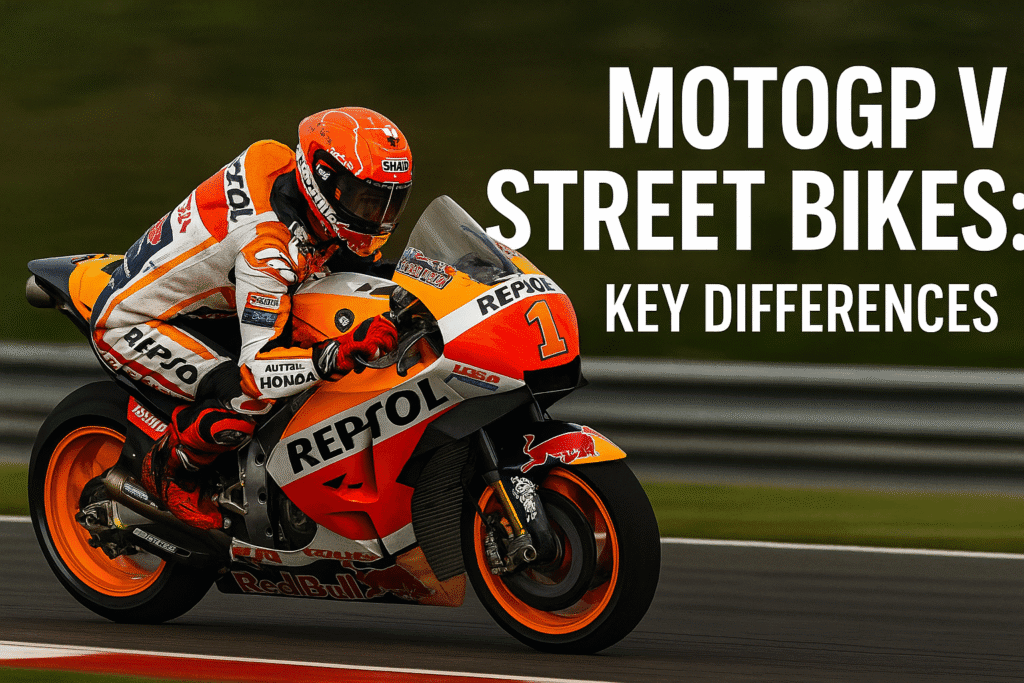
MotoGP vs Street Bikes: Key Differences
Performance Comparison
- Speed: MotoGP top speed exceeds 360 km/h, while most street bikes max out under 300 km/h.
- Acceleration: 0-100 km/h in ~2.6 seconds.
- Braking: Carbon brakes on MotoGP bikes vs steel on street bikes.
Design Philosophy
Street bikes prioritize longevity and comfort. MotoGP bikes sacrifice both for speed and agility.
Usability & Rider Experience
MotoGP bikes are track-only motorcycles with no lights, indicators, or concessions to comfort.
Expert Opinion: “Riding a MotoGP bike is like trying to tame a wild beast. They don’t forgive mistakes, but reward perfection.” — Former MotoGP Rider
Engineering Marvels Behind MotoGP Bikes
Carbon Fiber Use & Aerodynamics
Winglets, fairings, and aerodynamic tuning help create massive downforce and improve stability during cornering. Learn more about their role in racing motorcycle aerodynamics.
Seamless Gearboxes
These advanced transmissions allow clutchless, uninterrupted shifting at full throttle.
Data Telemetry & ECU Systems
MotoGP bikes use high-end ECU units that track and adjust every parameter in real time.
MotoGP Bike Performance Stats
| Metric | MotoGP Bike | Street Superbike |
|---|---|---|
| Top Speed | 360+ km/h | 300 km/h |
| Horsepower | 250+ HP | 200 HP (avg) |
| Weight | 157 kg (min) | 190+ kg |
| Lean Angle | 60+ degrees | 45-50 degrees |
| 0-100 km/h | ~2.6 seconds | ~3.2 seconds |
Curious about how these compare visually? Check out the Suzuki GSXR replica jacket.
MotoGP Bike Costs & Why They’re So Expensive
Development Budgets
Teams like Honda and Ducati spend millions annually on research and development.
R&D Investment Per Team
A single season’s bike can cost upwards of $3 million due to custom parts and prototype-only components.
Why They’re Not Sold to the Public
These bikes are not production legal and would be impractical (and illegal) on public roads.
How MotoGP Technology Filters Down to Road Bikes
Tech Transfer to Consumers
Many innovations debut in MotoGP before making their way to consumer models.
- Traction control
- Quick-shifters
- Cornering ABS
Brand Examples
- Ducati – Desmodromic valve systems
- Honda – Seamless gearboxes influence
- Yamaha – Balanced chassis design
Browse Valentino Rossi gear inspired by track legends.
Rider Impact on Bike Performance
Physical Demands
MotoGP riders endure up to 5G of force, requiring elite fitness and focus.
G-Forces, Braking Power
They brake from 350 km/h to 100 km/h in under 4 seconds. Riders must maintain total control throughout.
MotoGP Regulations & Their Impact on Design
- Engine restrictions: 1000cc limit
- Weight limits: Minimum 157kg
- Aero rules: Winglets regulated to reduce excessive downforce
MotoGP Bike Brands and Their Engineering Philosophies

Ducati: Power + Innovation
Famous for Desmodromic valve systems, aggressive aero, and high top-end speed.
Yamaha: Balance is Key
They prioritize smooth chassis geometry and consistent cornering.
Honda: Raw Performance
A power-first approach defines their engine and gear philosophy. Explore Honda gear.
MotoGP Tires: The Secret Weapon
- Temperature Management: Races won and lost based on tire heating.
- Compounds: Michelin supplies a variety of soft, medium, and hard options.
How Aerodynamics Shape MotoGP Performance
- Winglets: Increase front-end downforce.
- Fairings: Reduce air drag.
- Tail Units: Improve flow stability.
Shop aerodynamic replica gear for performance riding.
Electronics in MotoGP
- Ride-by-wire throttle
- Traction control
- Anti-wheelie
- Launch control
- Torque mapping systems
MotoGP Bike Lifespan: How Long Do They Last?
- Engine rebuild every 1,000 km or less
- Components replaced after each race
Built to perform, not to last. Own the look.
MotoGP vs Superbike vs Supersport
| Type | Power | Road Legal? | Top Speed |
| MotoGP | 250+ HP | No | 360+ km/h |
| Superbike | 200 HP | Yes | 300 km/h |
| Supersport | 120-140 HP | Yes | 240 km/h |
Training and Fitness for MotoGP Riders
- Daily strength and cardio routines
- Vision training and reflex sharpening
- Race simulation at high G-forces
Inspired? Get the pro look and feel track-ready.
FAQs
What makes a MotoGP bike different from a normal superbike?
It’s built for racing only, using prototype parts, carbon brakes, and top-tier electronics.
How much horsepower do MotoGP bikes have?
Over 250 horsepower depending on the engine setup.
What kind of engines do MotoGP bikes use?
1000cc four-stroke engines with high-rev tuning.
Are MotoGP bikes faster than Formula 1 cars?
No. F1 cars accelerate faster and have higher cornering speeds, but MotoGP bikes can rival them in straight-line acceleration.
Do MotoGP bikes use traction control or other rider aids?
Yes, including launch control, anti-wheelie, and torque mapping.
How much does a MotoGP bike cost?
Up to $3 million including R&D.
Can the public buy a MotoGP-spec bike?
No, but MotoGP replica bikes for sale and gear are available.
Why aren’t these bikes legal for the streets?
They lack lights, mirrors, and emissions compliance.
How do MotoGP bikes compare to street-legal superbikes like the Yamaha R1 or Ducati Panigale?
MotoGP bikes are lighter, more powerful, and use prototype tech.
What’s the top speed of a MotoGP bike vs a regular sports bike?
MotoGP: 360+ km/h. Street superbikes: ~300 km/h.
Explore race-ready gear, leather racing suits, MotoGP riding gloves, and pro motorcycle helmets at Motogp Gears – your trusted source for the best performance motorcycle gear online.