
Blog
Motorcycle Jackets: What Premium Materials Does MotoGPGears Use?


The motorcycle apparel market presents a significant challenge for riders: most jackets are marketed with the same vocabulary — “premium,” “protective,” “durable” — regardless of what is actually inside them. Shell materials, armor grades, thread specifications, and seam construction vary enormously between manufacturers, and those differences are rarely disclosed in product listings.
At MotoGPGears, every jacket begins as an engineering specification, not a design brief. Material selection is governed by protection performance first, then durability, then rider comfort. This page documents every material category we use across our jacket lineup — the grade, the standard it meets, and the reason it was specified over alternatives. If you are evaluating our products against competitors, this is the information you need to make that comparison accurately.
Why Material Selection Is a Safety Decision, Not a Style Choice
Material selection in motorcycle jackets directly influences how the garment performs under stress conditions such as high-speed slides, sudden impacts, and prolonged exposure to environmental factors.
The Role of Materials in Impact Absorption and Abrasion Resistance
During a crash, the outer shell of a jacket is subjected to intense friction against road surfaces. Materials with high Abrasion Resistance reduce the risk of tearing, which helps maintain a protective barrier between the rider and the ground. At the same time, internal structures must manage Impact Protection by distributing force across a wider surface area.
Equally important is seam integrity. Reinforced seams and high burst strength prevent structural failure at stress points, particularly along shoulders, elbows, and sleeves where force concentration is highest.
Why Cheap Alternatives Fail Under Real Riding Conditions
Lower-grade materials often fail due to insufficient tensile strength, poor stitching, and inconsistent thickness. These materials may appear similar visually but degrade rapidly under stress. In controlled abrasion tests, low-quality fabrics and split leather variants show significantly fewer resistance cycles compared to premium materials.
MotoGPGears designs jackets to exceed baseline Protective Gear Standards, ensuring that performance under real riding conditions aligns with laboratory-tested expectations.
The Leather MotoGPGears Uses: Grade, Source, and Treatment Process
Leather remains the most reliable outer shell material for high-speed riding applications due to its natural strength and abrasion performance.
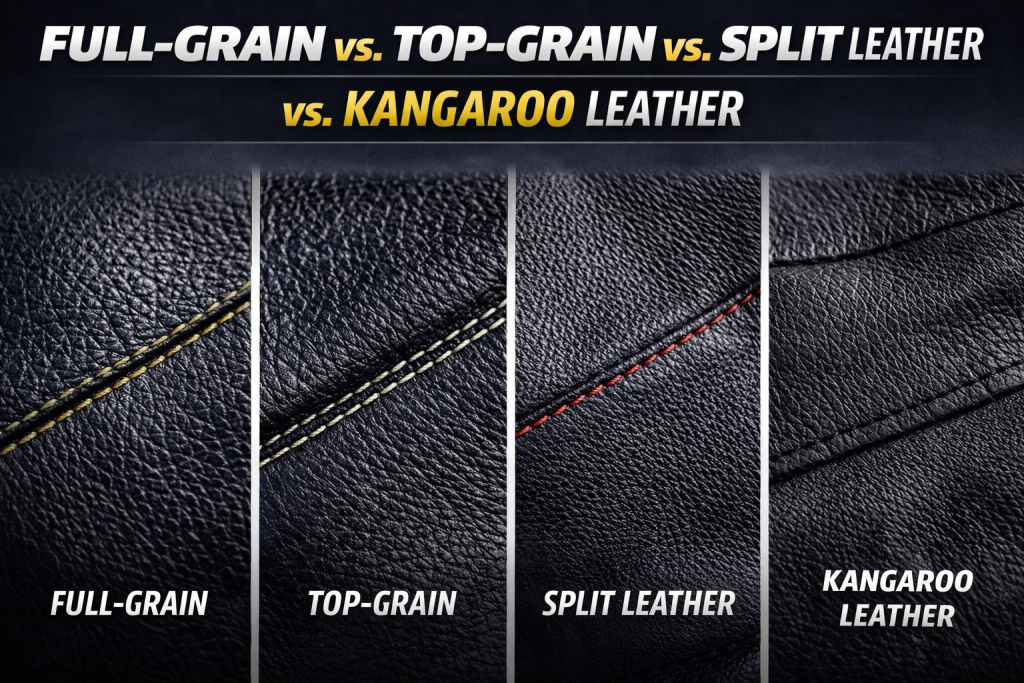
Full-Grain vs. Top-Grain vs. Split Leather: Where MotoGPGears Stands
MotoGPGears primarily uses Cowhide Leather in full-grain and top-grain configurations. Full-grain leather retains the outermost layer of the hide, offering maximum durability and resistance. Top-grain leather is slightly processed for consistency while maintaining structural strength.
Split leather, commonly used in low-cost jackets, is avoided due to its reduced fiber density and lower resistance under abrasion.
For racing applications, leather thickness is maintained between 1.0mm and 1.4mm to balance protection and flexibility. Chrome tanning is typically used to enhance durability, moisture resistance, and longevity.
Cowhide vs. Kangaroo Leather: Application by Jacket Type
Kangaroo Leather is utilized in high-performance racing jackets where weight reduction and flexibility are critical. It offers superior tensile strength relative to thickness, making it ideal for track environments.
Cowhide Leather remains the preferred material for street and touring jackets due to its robustness, availability, and balanced performance across various riding conditions.
How MotoGPGears Sources and Vets Its Leather Supply
All leather is sourced from vetted tanneries that meet strict processing and quality standards. Each batch undergoes inspection for thickness consistency, grain integrity, and tensile strength before entering production.
Textile and Synthetic Shell Materials Used in MotoGPGears Jackets
In addition to leather, MotoGPGears develops textile and hybrid jackets for riders requiring versatility and climate adaptability.

Cordura® Nylon: Construction Grade and Denier Specification
Cordura Fabric is used in high-denier constructions such as 600D, 1000D, and 1680D, depending on the application. Higher denier ratings correspond to increased fiber density and improved abrasion resistance.
These materials are selected for their durability, tear resistance, and ability to maintain structural integrity under repeated stress.
Kevlar® and Dyneema® Fiber Reinforcement
Kevlar Fiber reinforcement is integrated into high-impact zones such as elbows, shoulders, and back panels. These fibers provide exceptional resistance to cuts and heat while maintaining a relatively low weight.
Reinforcement panels are strategically placed rather than used across the entire shell to preserve flexibility without compromising safety.
Stretch Panels and Ventilation Mesh: Balancing Airflow with Protection
Stretch panels are incorporated in mobility zones to support Ergonomic Design and maintain rider comfort during extended use. At the same time, mesh and airflow sections are carefully engineered to ensure Airflow Panels do not weaken the overall structure.
The Ventilation System is designed to regulate airflow without exposing critical protection zones.
CE-Certified Armor and Impact Protection Systems
Protective armor is a core component of motorcycle jackets and plays a critical role in reducing injury severity during impact events.
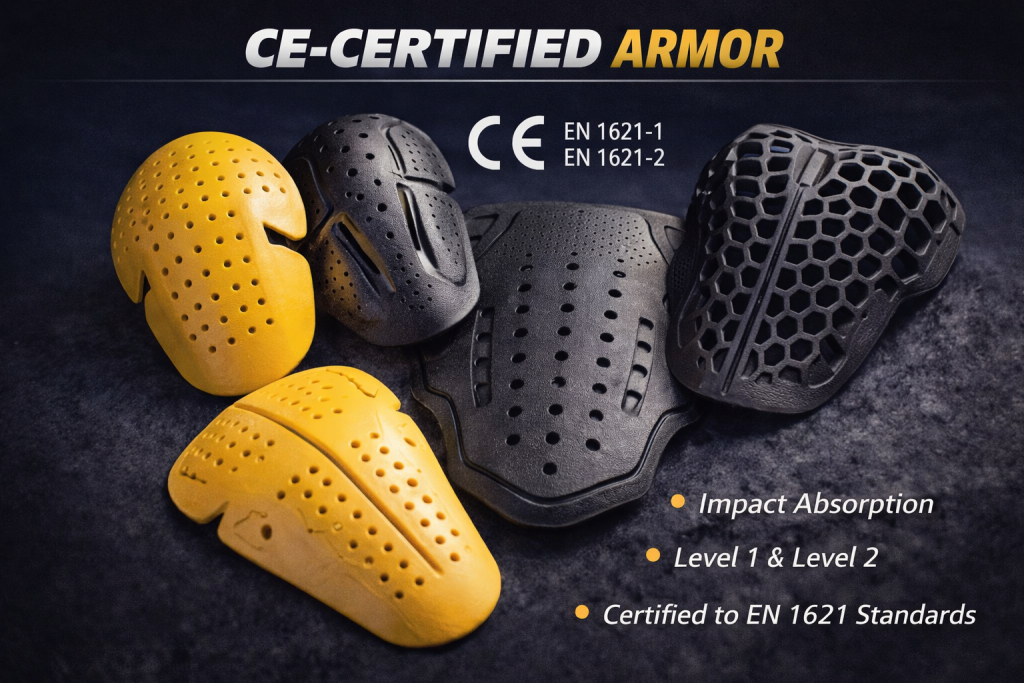
Understanding CE Level 1 vs. CE Level 2 Armor Certification
MotoGPGears integrates armor that complies with CE Certification (EN 1621-1 / EN 1621-2). Level 1 armor allows higher transmitted force, while Level 2 provides enhanced shock absorption and reduced force transfer.
Armor placement includes shoulders, elbows, and back, with higher-level protection used in high-risk zones.
D3O®, Poron XRD®, and Viscoelastic Foam: What MotoGPGears Chooses and Why
Different materials are used depending on application:
- D3O® offers rate-sensitive performance, remaining flexible under normal conditions and stiffening upon impact
- Poron XRD® provides consistent energy absorption through micro-cellular structure
- Viscoelastic foam serves as a cost-effective alternative while still meeting certification requirements
Back Protector Standards: Why MotoGPGears Includes Full-Back Coverage
Unlike many manufacturers that provide only armor pockets, MotoGPGears integrates full back protection aligned with EN 1621-2 Level 2 requirements to ensure continuous spinal coverage.
Chest Armor: The Most Overlooked Protection Zone
Chest protection is often excluded in standard jackets. MotoGPGears incorporates optional or integrated chest armor to improve upper-body protection, addressing a commonly neglected impact zone.
Lining Materials: Comfort, Moisture Management, and Thermal Regulation
Internal materials directly influence rider endurance and comfort during long rides.
Moisture-Wicking and Anti-Bacterial Inner Linings
Moisture-wicking linings help regulate sweat and reduce fatigue. These materials support Thermal Regulation by maintaining a stable microclimate inside the jacket.
Removable Thermal Liners: Construction and Insulation Materials
Removable liners allow seasonal adaptability. Insulated layers are designed to retain heat without excessive bulk, making jackets usable across a wide temperature range.
Waterproof Membrane Integration: Where MotoGPGears Uses Laminated vs. Drop-In Systems
MotoGPGears uses both laminated membranes and drop-in liners depending on jacket type. Laminated systems offer better water resistance, while drop-in liners provide flexibility and cost efficiency.
Stitching, Thread, and Seam Construction Standards
Structural integrity depends heavily on stitching quality and seam construction.
Double and Triple Stitching: Where MotoGPGears Applies Reinforced Seams
High-stress zones utilize Double Stitching / Triple Stitching to ensure durability. Reinforced Seams prevent separation under load and maintain jacket integrity during impact.
Thread Material: Polyester vs. Nylon vs. Kevlar® Thread
Thread selection is based on strength, UV resistance, and durability. High-stress areas may incorporate advanced thread materials to improve long-term performance.
Hardware, Zippers, and Fastening Systems
Hardware components are critical for both functionality and safety.
YKK® Zippers and Why Zipper Grade Matters in Motorcycle Apparel
MotoGPGears uses YKK Zippers due to their reliability and performance under stress. High-grade zippers reduce the risk of failure during impact or prolonged use.
Velcro®, Buckles, and Adjustment Systems: Materials and Durability Standards
Adjustment systems are designed to maintain secure fit and Riding Posture Design. Durable fastening materials ensure long-term usability under varying environmental conditions.
MotoGPGears Quality Control: How Materials Are Verified Before Production
Material performance is validated through a structured quality control process.
Pre-Production Material Testing Protocols
Materials undergo testing for tensile strength, Shock Absorption, and wear resistance before being approved for manufacturing.
Certifications and Compliance Standards MotoGPGears Meets
All products are developed in alignment with relevant safety standards and compliance frameworks, ensuring consistent performance across all product categories.
Choosing the Right MotoGPGears Jacket for Your Riding Style
Material selection should align with riding conditions and intended use.
Track and Racing: When Maximum Abrasion Resistance Is Non-Negotiable
Leather jackets with high-performance materials are recommended for track use where speed and impact risk are highest.
Street and Commuter Riding: Balancing Protection with All-Day Comfort
Hybrid and textile jackets provide a balance between protection and comfort for daily riding.
Adventure and Touring: Multi-Climate Material Priorities
Touring jackets prioritize weather resistance, modular liners, and durable textile shells for long-distance travel.
Frequently Asked Questions About MotoGPGears Jacket Materials
What leather grade does MotoGPGears use in its racing jackets?
Full-grain and top-grain leather are used for maximum durability and protection.
Are MotoGPGears jackets CE certified?
Yes, armor components meet CE standards for impact protection.
What is the difference between D3O® and standard foam armor?
D3O® is flexible under normal conditions and hardens on impact, offering improved protection.
Does MotoGPGears use genuine Cordura® fabric or generic nylon?
Genuine Cordura® is used in textile jackets for durability and performance.
How do I know which jacket material is right for my climate?
Leather suits cooler and high-speed conditions, while textile jackets are better for warmer climates.
Are MotoGPGears jackets tested before shipping?
Yes, all jackets undergo inspection and quality checks before dispatch.