
Blog
How Safe Are Motorcycle Racing Jackets at High Speeds?


At high speeds, crash physics change fundamentally. Kinetic energy increases with the square of speed, meaning a fall at 160 km/h involves several times more energy than one at urban road speeds. This energy must be managed through controlled sliding, load distribution, and structural integrity of the gear. Motorcycle racing jackets are engineered around this reality.
Street riding crashes are often unpredictable, involving obstacles, vehicles, or abrupt impacts. Track crashes, while still dangerous, are more consistent in pattern: loss of traction, separation from the motorcycle, followed by sliding and sometimes tumbling across a known surface. Racing jackets are designed for these predictable sequences, emphasizing abrasion resistance, seam strength, and stable armor positioning rather than impact dispersion alone.
The riding environment also matters. Tracks offer uniform asphalt, runoff areas, and fewer fixed hazards, allowing gear to function as intended. High-speed safety, therefore, is not simply “more protection,” but different protection—optimized for sustained energy management rather than short, chaotic impacts.
2. What Actually Happens to the Body in a High-Speed Crash
In a high-speed low-side crash, the rider typically separates from the motorcycle and enters a long slide. Abrasion becomes the dominant injury mechanism, with friction generating significant heat and material stress. If the slide destabilizes, tumbling introduces rotational forces that load joints and soft tissue.

High-side crashes are more violent. Sudden traction recovery ejects the rider upward, leading to higher impact forces on landing. These events combine blunt force trauma with secondary abrasion once the rider contacts the surface again. Shoulders, hips, and knees are common load points due to body orientation during ejection.
Across both scenarios, injuries result from three main vectors: abrasion removing protective layers, blunt force overwhelming armor absorption, and joint loading exceeding anatomical limits. Racing jackets address some of these forces, but they cannot eliminate them. Understanding these mechanics is essential to evaluating what a jacket can realistically protect against.
3. Materials That Determine High-Speed Safety Performance
Material selection and construction quality largely determine whether a jacket survives a high-speed crash intact. At racing speeds, failure is rarely cosmetic; material breakdown exposes the rider directly to the surface.
Leather vs Textile at Racing Speeds
Full-grain leather remains dominant in racing applications due to its high tensile strength, tear resistance, and predictable abrasion behavior. Cowhide offers durability and thickness, while kangaroo leather provides similar strength at lower mass, improving mobility without reducing protection. Most textiles struggle to maintain structural integrity during long slides at high speeds, particularly at seams and high-friction zones.
Critical Zones & Layer Mapping
Racing jackets use zone-based construction. Impact and slide zones—shoulders, elbows, and outer arms—receive additional layers or thicker panels, while flex zones prioritize mobility. This mapping ensures that material strength is concentrated where failure risk is highest, without restricting rider movement in a racing posture.
Stitching, Thread & Seam Construction
Seams are common failure points. High-speed abrasion can rapidly erode exposed stitching, leading to panel separation. Bonded high-strength threads and multi-row stitching increase seam burst resistance, ensuring the jacket remains intact long enough to protect the rider throughout the slide.
4. Armor Systems: What Protects You When You Hit the Track
Armor systems are designed to reduce peak impact forces transmitted to the body. Modern racing jackets typically use viscoelastic protectors that deform under load, absorbing and dispersing energy. The effectiveness of this system depends less on thickness alone and more on correct positioning over anatomical landmarks.
Certification benchmarks, such as CE-rated armor, provide a baseline for energy absorption under controlled testing. However, armor only functions as intended if it stays in place during a crash. Poor fit or excessive jacket movement can allow protectors to rotate away from impact zones, significantly reducing their protective value. Armor mitigates impact injuries, but it does not address abrasion or internal trauma on its own.
5. Abrasion Resistance: Why Slide Time Matters More Than Speed
Abrasion injury severity is influenced more by slide duration than peak speed. A rider sliding for several seconds generates sustained friction, producing heat that can degrade materials. Leather’s ability to char rather than melt provides a critical advantage, maintaining a protective barrier longer than many synthetics.
Surface type also matters. Track asphalt is generally more uniform, while concrete generates higher friction and accelerates material wear. Jackets are engineered with these realities in mind, but no material offers unlimited abrasion resistance. The goal is to delay failure long enough to prevent skin exposure during the slide.
6. Fit, Ergonomics & Jacket Stability at Speed
Fit is a safety parameter, not a comfort preference. Racing jackets are cut for a forward-leaning posture, ensuring that armor aligns correctly when the rider is in position. Excess material can cause bunching, while overly loose jackets allow armor migration during a crash.
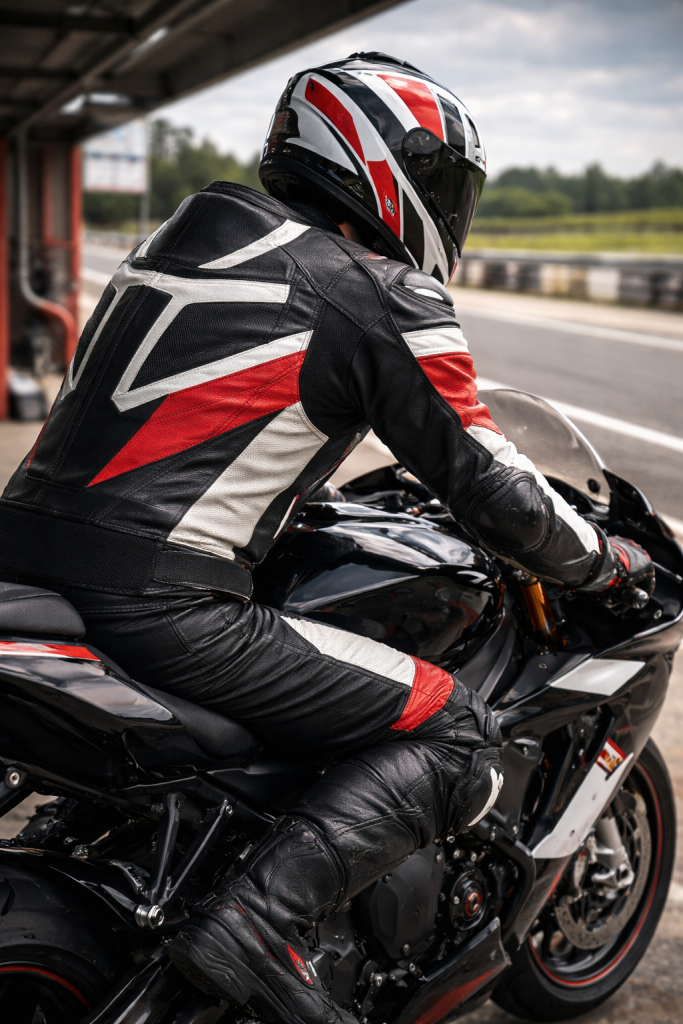
A properly fitted jacket feels snug when standing but neutral on the bike. Tightness should not restrict breathing or arm movement. Stability at speed ensures that protective elements remain where they are needed when forces are applied suddenly.
7. Jacket-to-Pants Connection: A Critical Safety Interface
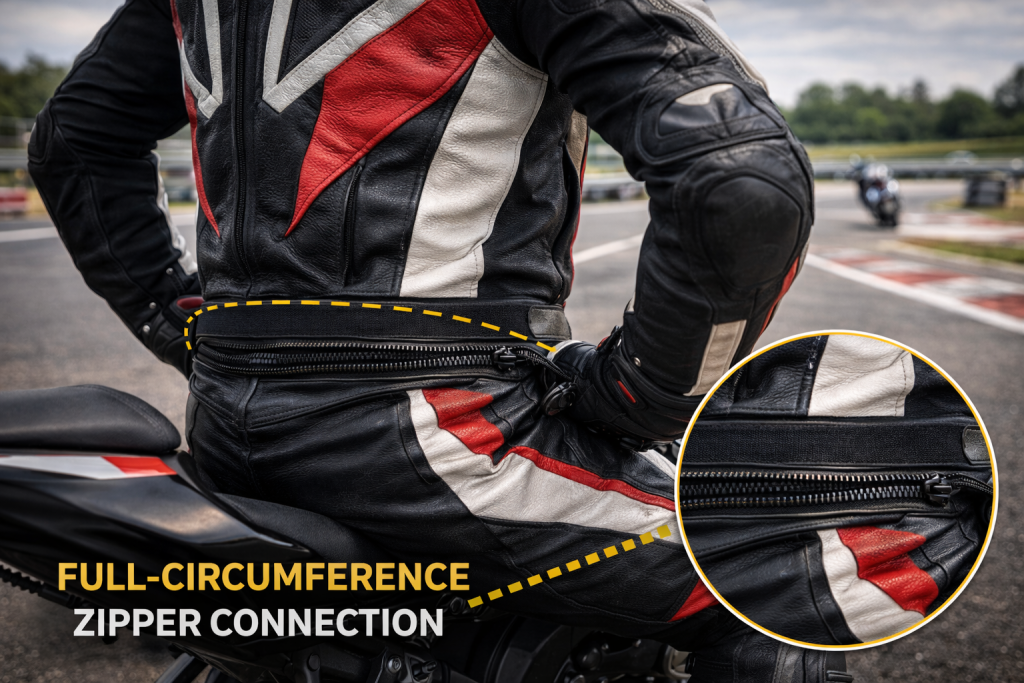
During a slide, centrifugal forces and surface friction can pull a jacket upward. Without a secure connection to the pants, this exposes the lower back and abdomen. Full-circumference zipper systems significantly reduce this risk by keeping the jacket anchored.
One-piece race suits inherently eliminate this interface, offering superior stability. Two-piece systems can approach similar safety levels if the connection is robust, but short zippers provide limited protection against ride-up in high-speed slides.
8. Ventilation vs Structural Integrity at High Speeds
Ventilation improves thermal comfort but introduces structural compromises. Perforation reduces material mass and can create tear initiation points if poorly executed. Racing jackets balance airflow by concentrating perforation in low-impact zones while maintaining solid panels in high-risk areas.
At sustained high speeds, heat management is important, but it must not undermine abrasion resistance. Effective design prioritizes controlled ventilation without sacrificing core structural strength.
9. Certification & Standards: What the Labels Really Mean
Protective garment standards, such as EN 17092, define minimum performance thresholds for abrasion, tear strength, and seam integrity under laboratory conditions. These tests provide consistency and comparability but cannot replicate every real-world crash variable.
Certification indicates that a jacket meets defined criteria, not that it guarantees safety in all scenarios. Real crashes involve variables—angle, surface condition, rider mass—that exceed controlled testing. Standards are a baseline, not a prediction of outcome.
How to Ride Safely at High Speeds (Gear Alone Is Not Enough)
Choose the Right Environment
High-speed riding belongs on closed circuits designed for it. Tracks offer predictable surfaces, runoff areas, and emergency response, reducing injury severity compared to public roads where hazards are uncontrolled.
Maintain a Stable Riding Posture
A relaxed upper body and engaged lower body improve motorcycle stability. Proper posture reduces sudden load transfers that can initiate loss of traction and improves control during high-speed cornering.
Throttle, Braking & Input Discipline
Smooth, progressive inputs preserve traction. Abrupt throttle or brake application at lean can overwhelm available grip, leading to crashes that no jacket can fully mitigate.
Understand Tire Temperature & Grip
Tire grip is temperature-dependent. Cold tires offer reduced traction, increasing crash risk early in sessions. Awareness of tire condition directly influences safety outcomes at speed.
Fatigue Management at High Speed
Fatigue degrades reaction time and decision-making. Many high-speed incidents occur late in sessions when concentration drops. Managing hydration and rest is part of riding safely.
Gear as a System, Not a Single Jacket
A racing jacket functions as part of a broader protective system including gloves, boots, back protection, and, in higher-risk environments, airbag systems. Omitting components increases injury risk exponentially.
11. Limitations of Motorcycle Racing Jackets at Extreme Speeds
Racing jackets protect against abrasion and moderate impacts, but they cannot prevent internal injuries caused by rapid deceleration or extreme forces. Organs and skeletal structures have physical limits that no garment can overcome.
At very high speeds, energy levels may exceed the capacity of protective materials. Jackets are designed to reduce injury severity, not eliminate it. Acknowledging these limits is essential to making informed safety decisions.
12. How to Choose the Right Racing Jacket for Your Speed & Use
Riders participating in occasional track days have different needs than competitive racers. Speed range, riding posture, and climate all influence jacket selection. Aggressive riding positions demand race-cut ergonomics, while hotter environments require careful ventilation balance.
As speeds increase and riding becomes more competitive, a full race suit often provides better overall protection due to integrated construction and reduced interface risks. Jacket choice should align with actual use, not aspirational riding.
13. Final Takeaway: Are Motorcycle Racing Jackets Safe at High Speeds?
Motorcycle racing jackets provide meaningful protection when used in the conditions they are designed for. They manage abrasion, distribute impact forces, and maintain structural integrity during high-speed crashes. However, they are only one component of rider safety.
Safety at speed is a system involving gear, environment, riding technique, and judgment. Understanding what a jacket can and cannot do allows riders to make realistic decisions and ride within informed limits.