
Blog
Best Jackets for Sport Bikes (R1, CBR, GSX-R Riders)


1. Introduction – Why Supersport Riders Require Race-Spec Jackets
Supersport motorcycles place the rider in a forward-biased posture with significant upper body load over the tank. At highway and track speeds, aerodynamic pressure acts directly on the chest, shoulders, and upper arms. Above 80 mph, airflow resistance becomes structurally relevant to garment stability, particularly at the collar, shoulder seam junctions, and waistline.
In a slide scenario, first-contact probability is concentrated at the shoulder cap, elbow, and outer forearm. Due to higher entry speeds typical of 600cc–1000cc sport platforms, abrasion duration increases compared to upright motorcycles.
Jackets designed for relaxed or cruiser ergonomics typically use neutral sleeve geometry and extended torso length. In a tuck position, these garments pull at the trapezius, lift at the waist, and allow elbow armor displacement. A race-cut leather jacket is engineered specifically for forward articulation, aerodynamic stabilization, and impact-zone reinforcement. For supersport riding, this is a structural requirement rather than a stylistic preference.
2. Ergonomic Demands of Supersport Motorcycles
Supersport geometry creates a 35–45° forward torso inclination. This position induces shoulder protraction, sustained elbow flexion, and wrist extension due to low clip-on placement. The rider maintains cervical extension to preserve forward visibility.
Garment patterning must account for:
- Forward shoulder pitch
- Rotational loading across the deltoid
- Constant elbow flexion radius
- Reduced abdominal extension in tuck
Pre-curved sleeves replicate the natural arc of the arm during riding. Without pre-curvature, leather tension accumulates across the anterior shoulder and triceps, increasing resistance and restricting throttle modulation.
During counter-steering input, the upper sleeve seam experiences torsional stress. If seam placement intersects this high-load area, structural fatigue accelerates. Additionally, in non-race garments, elbow armor often migrates medially under flexion, reducing effective impact coverage.
A race-oriented jacket maintains armor alignment over the acromion and olecranon processes throughout dynamic movement. Rear expansion panels compensate for scapular movement without increasing frontal looseness, preserving aerodynamic efficiency.
3. Technical Construction Requirements
3.1 Leather Specification
Supersport applications require 1.2–1.3 mm top-grain cowhide to provide appropriate abrasion resistance and seam stability. Tensile strength determines resistance to tearing under load, while tear resistance measures the force required to propagate an existing cut. Both parameters are critical in high-velocity slide events.
Kangaroo leather panels may be incorporated for superior strength-to-weight ratio. Due to its fiber density, comparable abrasion performance can be achieved at reduced thickness, lowering total garment mass while maintaining integrity.
CE AA and AAA garment classifications evaluate abrasion time, seam strength, and tear resistance under standardized testing. AAA-rated garments provide extended abrasion duration margins, particularly relevant for frequent high-speed riding.
3.2 Abrasion Zone Mapping
Primary abrasion zones include:
- Shoulder caps
- Elbows and outer forearm
- Lateral back panels
- Lower flank region
These areas may incorporate double leather overlays or internal aramid reinforcement layers. External TPU shoulder sliders reduce frictional grab during initial ground contact, encouraging controlled slide dynamics.
Critical seams are relocated away from direct impact zones and reinforced with multi-row safety stitching. Seam failure probability must remain lower than leather substrate failure under test conditions.
3.3 Impact Protection System
CE Level 1 armor provides baseline impact attenuation; CE Level 2 reduces transmitted force to lower kilonewton thresholds during testing. For supersport use, Level 2 shoulder and elbow protectors are recommended.
Back protector pockets must accommodate certified inserts providing full spinal coverage. Energy absorption metrics determine transmitted force during impact simulation. Armor retention systems must prevent displacement under rotational load.
4. Aerodynamic & Structural Features
A speed hump assists in airflow stabilization behind the helmet, reducing turbulence across the upper back at elevated speeds. It may also serve as structural housing for back protectors or hydration channels in track-oriented configurations.
A 360° pant zipper provides full circumferential integration between jacket and trousers, preventing upward migration during high-speed airflow or slide events. Short connection zips offer partial retention but reduced structural continuity.
Waist retention systems utilize adjustable straps or internal grip panels to stabilize the torso. Sleeve articulation panels and accordion stretch zones at the posterior shoulder and elbow crease permit range of motion without increasing overall looseness.
5. Ventilation Engineering for High-RPM Riding
Perforated leather maximizes passive airflow, suitable for sustained high ambient temperatures. Micro-perforation balances airflow with increased surface strength.
Effective systems position chest intake panels within stagnation pressure zones and rear exhaust vents in low-pressure areas to promote airflow circulation. Internal mesh liners manage moisture through capillary wicking, supporting thermal regulation during high engine output operation.
Seasonal suitability depends on perforation density, liner configuration, and riding duration. Hybrid configurations provide broader operational range.
6. Model-Specific Fit Considerations
The Yamaha YZF-R1 presents a pronounced forward bias and compact cockpit, increasing torso compression and requiring aggressive sleeve pre-curve and reduced abdominal length.
The Honda CBR1000RR maintains balanced supersport ergonomics. Jackets compatible with this platform benefit from moderate rear expansion and precise shoulder alignment.
The Suzuki GSX-R1000 typically positions the rider within a compact upper body triangle, demanding accurate hem length control to prevent tank interference under braking.
Tank width, seat-to-bar distance, and peg height all influence articulation requirements. Improper jacket length can fold at the abdomen or restrict tuck depth.
Based on these construction and ergonomic principles, jacket selection should align with riding intensity.
7. Jacket Selection by Riding Intensity
A. Track-Focused Riders
Track applications require full race-cut construction, Level 2 armor, aerodynamic hump integration, and extensive perforation.
Recommended models:
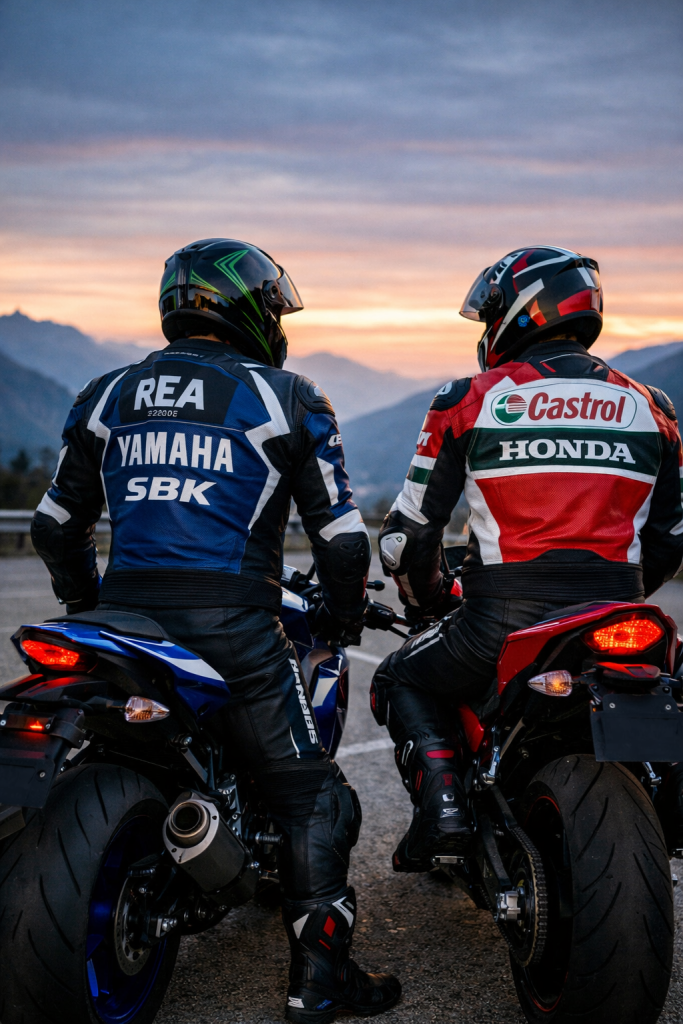
- Jonathan Rea Yamaha SBK 2025 Real Leather Custom Jacket
https://motogpgears.uk/product/jonathan-rea-yamaha-sbk-2025-real-leather-custom-jacket/ - Maverick Viñales Moto 2024 Aprilia Race Jacket
https://motogpgears.uk/product/maverick-vinales-moto-2024-aprilia-race-jacket/
These jackets feature structured race silhouettes, reinforced shoulder zones, pre-curved sleeves, and pant connection compatibility suitable for sustained high-speed operation.
B. Street–Track Hybrid Riders
Hybrid riders require race-oriented patterning with moderate daily usability and ventilation balance.
Recommended models:
- Johann Zarco Castrol Honda Motorcycle Leather Jacket
https://motogpgears.uk/product/johann-zarco-castrol-honda-motorcycle-leather-jacket/ - Miguel Oliveira Yamaha Pramac Motorbike Racing Jacket
https://motogpgears.uk/product/miguel-oliveira-yamaha-pramac-motorbike-racing-jacket/
These configurations maintain abrasion-resistant leather thickness, armor accommodation, and structured articulation while allowing practical road use.
C. Aggressive Street Supersport Riders
For short-duration high-speed use in urban environments:
- Alex Lowes Bimota Kawasaki Leather Moto Jacket
https://motogpgears.uk/product/alex-lowes-bimota-kawasaki-leather-moto-jacket/
This model maintains sport-cut geometry, ventilated leather panels, and CE armor compatibility without full track-specific bulk.
Selection should be determined by exposure level, riding frequency, and protective requirement rather than graphic preference.
8. Fitment & Measurement Guidelines
A race jacket should feel restrictive when upright yet neutral in tuck position.
Measurement protocol:
- Chest circumference at full inhalation
- Shoulder alignment at acromion
- Sleeve length measured with elbows flexed
- Torso length sufficient to prevent lumbar exposure
With arms flexed, elbow armor must remain centered over the olecranon. Shoulder protectors must fully cover the acromial region. Proper fit ensures both aerodynamic stabilization and impact protection integrity.
9. Frequently Asked Technical Questions
Is CE AAA necessary for street supersport riding?
AAA provides extended abrasion duration margins. For frequent high-speed riding, it increases protective buffer but is not universally required.
Is kangaroo leather worth the cost?
It offers superior strength-to-weight ratio and improved flexibility, reducing garment mass while maintaining abrasion resistance.
Do I need a speed hump for non-track riding?
Not mandatory, but beneficial for sustained high-speed aerodynamic stability and larger back protector accommodation.
Can airbag systems be worn under race jackets?
Only if the jacket provides adequate expansion volume and manufacturer clearance for inflation deployment.
10. Conclusion – Equipment Engineered for Supersport Performance
Supersport platforms impose aerodynamic and biomechanical demands that require race-oriented garment construction. Appropriate leather thickness, abrasion zone reinforcement, CE-certified impact protection, and articulated pattern drafting are essential for maintaining structural integrity at speed.
Selection should align with riding intensity and exposure level. A properly engineered race-cut leather jacket maintains armor alignment, resists aerodynamic lift, and provides controlled abrasion performance under load. Technical construction defines suitability for high-performance sport motorcycles.