
Blog
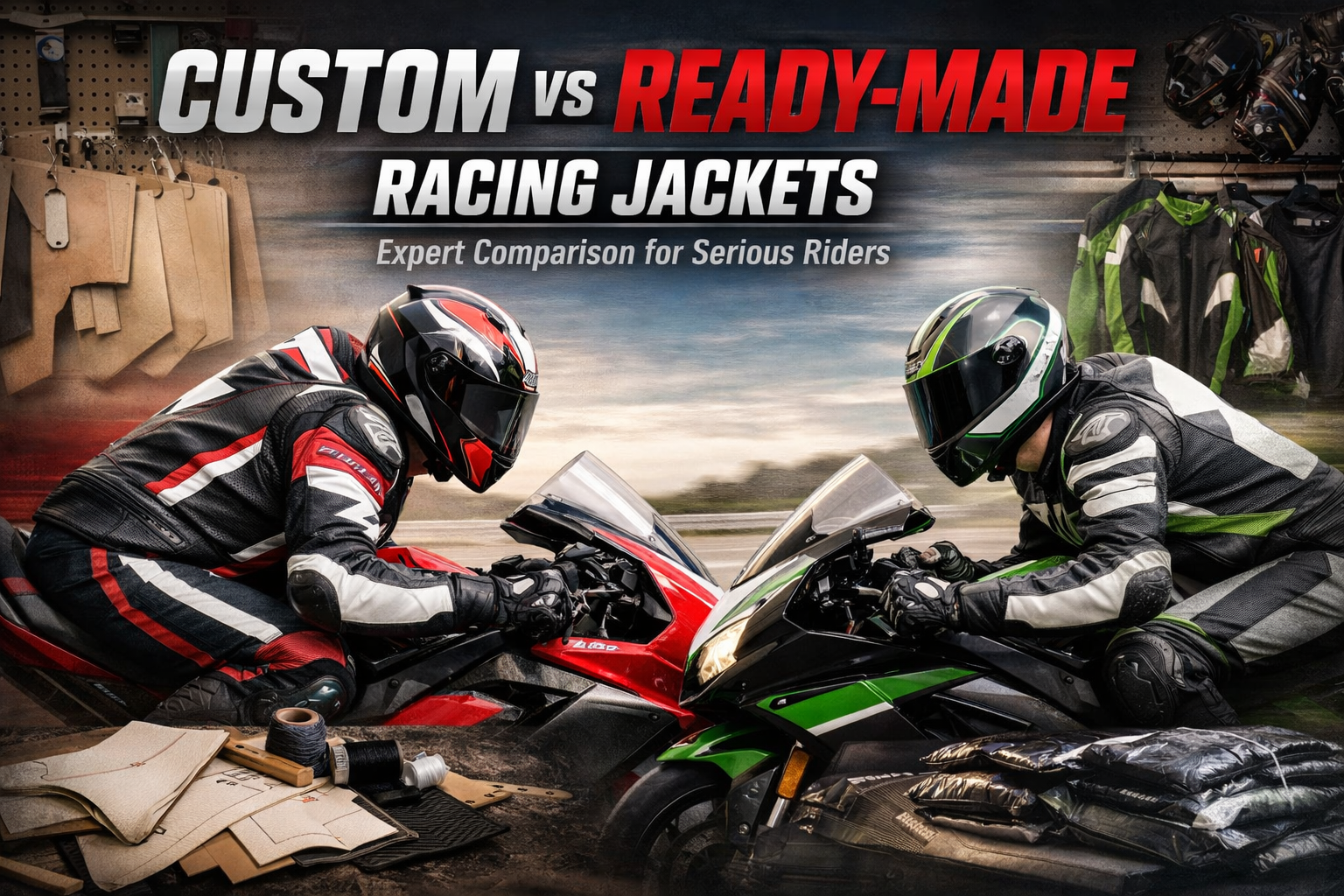
Custom or Ready-Made Racing Jackets? Expert Comparison for Serious Riders

1. Introduction: Why Jacket Construction Matters at Speed
At performance speeds, a motorcycle jacket functions as protective equipment—not apparel. Its purpose is to manage impact energy, resist abrasion, and maintain structural stability under wind pressure.
If armor shifts, protection is compromised.
If seams fail, abrasion resistance ends.
If fit is unstable, aerodynamic fatigue increases.
Safety depends on alignment, material integrity, and construction accuracy. The difference between ready-made and custom construction is not cosmetic—it is biomechanical.
2. What Defines a Ready-Made Racing Jacket?
Ready-made jackets are produced using standardized grading systems. One base pattern is proportionally scaled across sizes, assuming average shoulder angles, torso length, and arm rotation.
They are engineered around population averages—not individual anatomy.
Typical characteristics include:
- Batch production from a single master pattern
- Fixed armor pocket placement
- 1.2–1.3mm leather thickness
- Use of corrected-grain leather for uniform surface finish
- Integrated CE Level 1 shoulder and elbow protectors
These jackets perform adequately when body proportions closely match sizing charts. Misalignment increases as proportions deviate.
3. What Defines a Custom Racing Jacket?
Custom construction begins with individual measurement analysis. The pattern is drafted specifically for the rider’s posture, proportions, and intended use.
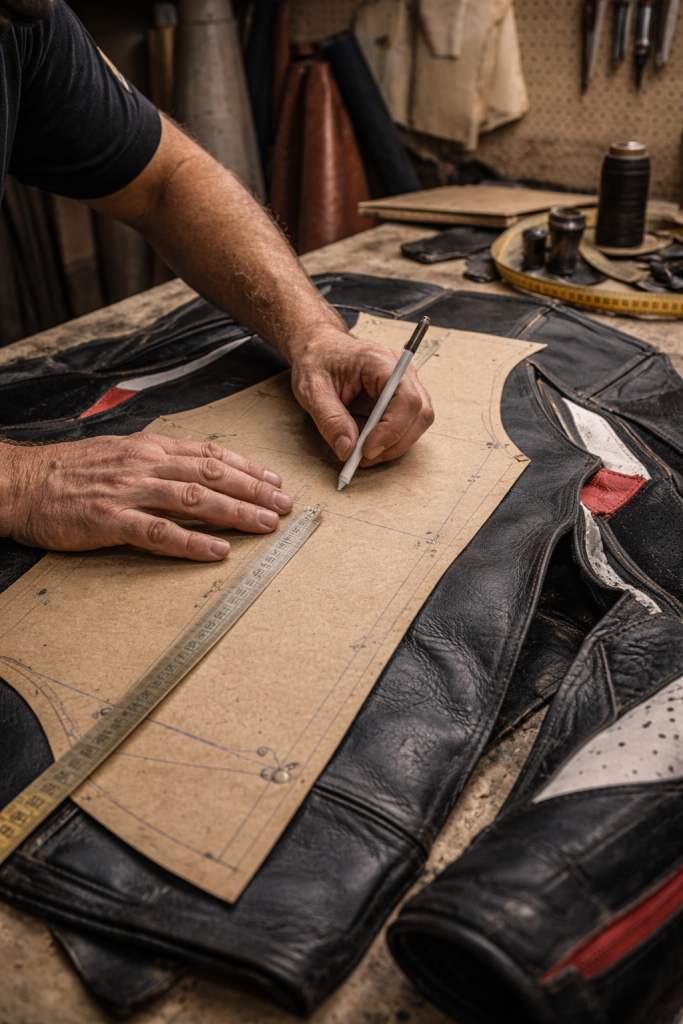
The structure adapts to the rider—not the reverse.
Technical elements include:
- Measurement-specific pattern drafting
- Armor pocket calibration for joint alignment
- Selection of top-grain leather for higher fiber integrity
- Integration of CE Level 2 protection when required
- Stretch zones reinforced with Kevlar for tensile stability
This approach improves armor positioning accuracy and reduces excess material that can destabilize airflow.
4. Fit & Ergonomics: The Most Critical Difference
4.1 Off-the-Rack Fit Limitations
Standard grading assumes predictable shoulder slope and torso ratios. Real riders vary significantly.
Common issues include:
- Elbow armor drifting during throttle engagement
- Excess torso material creating turbulence
- Lower back bunching in tuck position
- Increased aerodynamic drag at speed
Improper fit directly reduces protection efficiency.
4.2 Made-to-Measure Ergonomic Mapping
Custom drafting accounts for riding posture before cutting begins. Sleeves are pre-curved, and panel geometry follows natural joint articulation.
Key advantages include:
- Stable elbow articulation zones
- Reduced seam stress during flexion
- Cleaner waist taper for airflow control
- Improved armor retention during impact
When posture and structure align, protection performance improves.
5. Protection Engineering Comparison
5.1 Impact Protection
Impact absorption depends on stability. A protector must remain correctly positioned at the moment of contact.
In ready-made jackets, pocket placement cannot adapt to individual anatomy. In custom construction, pocket depth and placement are measurement-based.
Alignment determines energy dispersion efficiency.
5.2 Abrasion Resistance
Abrasion protection depends on hide density and seam engineering, not thickness alone.
Critical factors include:
- Fiber structure quality
- Stitch density (8–10 stitches per inch typical in performance builds)
- Safety seam construction with hidden reinforcement
Seams typically fail before leather does. Construction quality is decisive.
5.3 Structural Reinforcement
High-impact zones require rotational management during slide events.
Reinforcement typically includes:
- External TPU sliders to reduce grab
- Reinforced shoulder and elbow panels
- Triple stitching in stress zones
Reinforcement must match anatomical impact zones—not generic layouts.
6. Material & Construction Differences
Material quality alone does not define performance. Construction geometry and hardware reliability are equally important.
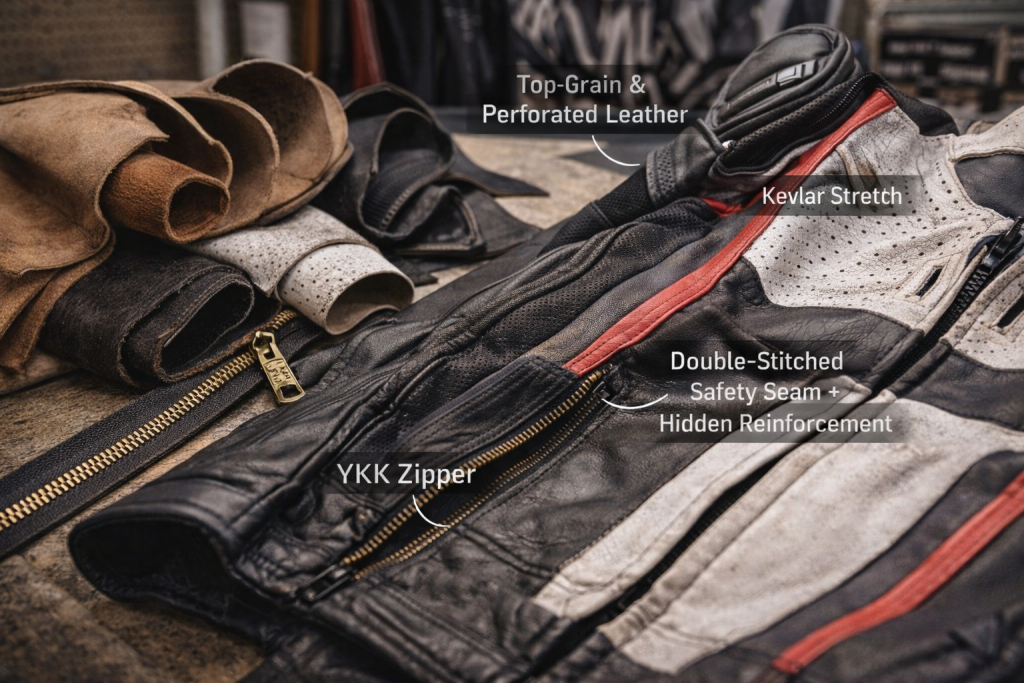
Key technical elements:
- Tanning process affecting fiber cohesion
- Stretch panel elasticity retention
- Double-stitched safety seams with concealed reinforcement
- High-load closure systems such as YKK zippers
Material strength without structural precision limits effectiveness.
7. Performance at Speed: Aerodynamics & Stability
At speed, airflow stability affects endurance and control. Excess material increases turbulence and raises drag coefficient.
Performance factors include:
- Back hump airflow management
- Waist taper stability under acceleration
- Controlled sleeve fit to prevent lift
A stable garment reduces fatigue and maintains armor alignment.
8. Durability & Long-Term Value
Durability is determined by stress distribution and seam fatigue resistance over time.
Long-term performance depends on:
- Panel geometry reducing tension concentration
- Hardware endurance
- Repairability and panel replacement feasibility
Structural retention over years defines real value.
9. Cost Breakdown: What You Are Actually Paying For
The cost difference reflects production complexity—not branding.
Ready-made pricing reflects:
- Scaled pattern usage
- Volume material purchasing
- Reduced labor time per unit
Custom pricing reflects:
- Individual drafting
- Manual cutting
- Measurement calibration
- Increased assembly time
Precision requires labor. Labor increases cost.
10. Who Should Choose Ready-Made?
Ready-made construction is appropriate when performance demands are moderate and sizing aligns closely with grading charts.
It suits:
- Riders within standard proportions
- Casual or moderate-speed street use
- Occasional track-day riders
- Riders prioritizing availability over calibration
11. Who Should Choose Custom?
Custom construction becomes necessary when alignment precision and aerodynamic control matter.
It suits:
- Frequent track riders
- Amateur racers
- Riders with non-standard body proportions
- High-speed performance riders
- Riders prioritizing armor stability
The more aggressive the riding, the more critical the calibration.
12. Common Misconceptions About Custom Jackets
Several assumptions reduce understanding of protective engineering.
Common misunderstandings include:
- Custom only changes appearance
- Standard sizing protects equally
- All leather performs the same
- Fit does not influence safety
Fit directly controls protection alignment and aerodynamic stability.
13. As an Expert, I Recommend You Buy Custom Jackets
From a manufacturing perspective, protective equipment must perform predictably under load.
Custom construction provides:
- Measurable armor alignment accuracy
- Reduced aerodynamic instability
- Improved seam stress distribution
- Better long-term structural retention
Statistical sizing cannot account for individual biomechanics.
For serious riders, precision improves safety margins.
14. Final Technical Recommendation
If your riding remains moderate and your body proportions align with standard grading, ready-made construction is sufficient.
If you ride aggressively, attend frequent track sessions, or compete:
Custom construction is the technically correct choice.
At performance speeds, precision determines protection efficiency.