
Ultimate Motorcycle Racing Jacket – 2025 Buying Guide
This guide is intended for riders who operate motorcycles in environments where protective apparel is exposed to high kinetic energy, repeated load cycles, and sustained abrasion risk. These conditions are typical in closed-circuit riding and high-performance sport riding.
Track riders require jackets that maintain structural stability during hard braking, deep lean angles, and extended sliding events. Armor must remain aligned under centrifugal force, and seams must tolerate shear loads generated during asphalt contact.
Race school riders experience repeated low-speed incidents that quickly reveal weaknesses in seam construction, leather quality, and armor retention. Sport riders riding aggressively on public roads subject jackets to similar ergonomic stresses, particularly through the shoulders and elbows.
This guide does not address casual riding or urban commuting. It assumes the reader evaluates a racing jacket as a functional safety system rather than a comfort or style garment.
What Defines a True Motorcycle Racing Jacket
A motorcycle racing jacket is a purpose-built protective garment engineered to manage abrasion, impact energy, and garment stability during high-speed incidents. Its performance is defined by construction and material behavior, not visual appearance. This is why understanding the cheap and expensive jacket difference is crucial for riders who want genuine protection rather than just style.
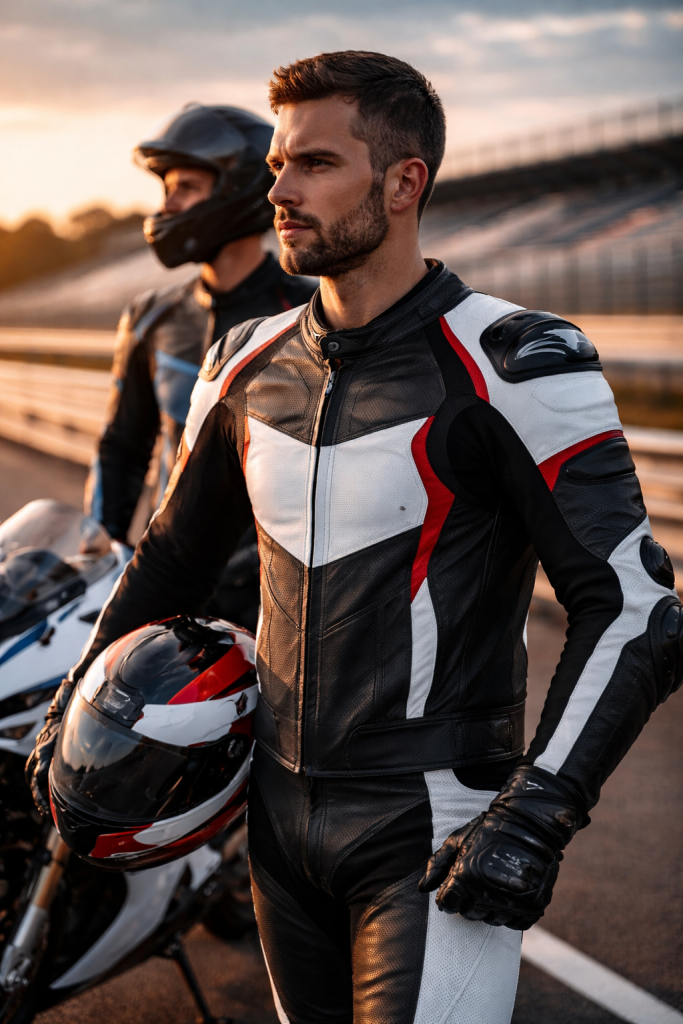
Racing jackets are patterned for a sustained forward-leaning posture. Pre-curved sleeves, rotated arm panels, and elevated elbow articulation ensure that armor remains correctly positioned while riding. A shortened front length prevents material compression when the rider is tucked.
The defining characteristics of a racing jacket include controlled material continuity across impact zones and predictable behavior under load. Failure thresholds are engineered to delay seam separation and prevent skin exposure during a slide.
Leather Types Used in Racing Jackets
Leather remains the primary abrasion-resistant material used in racing jackets due to its fibrous structure and predictable wear characteristics under sliding conditions.
Full-grain cowhide is widely used because it offers consistent fiber density, reliable tear resistance, and stable performance across varying thickness ranges. When sourced and processed correctly, it provides repeatable protection characteristics.
Kangaroo leather is selected in weight-sensitive applications. Its tighter fiber structure allows thinner panels without proportional loss of abrasion resistance. This reduces overall garment mass and improves rider mobility but requires precise cutting and reinforced seam design.
Hide thickness in racing jackets typically falls between 1.2 and 1.4 millimeters. Thinner hides improve flexibility but reduce abrasion duration, while thicker hides increase slide resistance at the cost of mobility—one of the material trade-offs discussed in 7 Costly Mistakes to Avoid When Buying a Racing Jacket. Drum-dyed leather is preferred because pigment penetration preserves surface integrity after abrasion, unlike surface-coated hides that lose finish without structural benefit.
Abrasion Resistance & Impact Protection Systems
Abrasion resistance depends on material durability and panel placement. High-risk zones include shoulders, elbows, forearms, and the upper back, where initial impact and prolonged sliding commonly occur.
In these areas, uninterrupted leather panels are critical. Seam exposure is minimized to reduce tear initiation under shear loading. Panel layout is determined by crash data rather than aesthetic symmetry.
Impact protection systems operate independently from abrasion layers. Armor must remain positioned over skeletal landmarks during dynamic movement. Pocket geometry, retention depth, and opening orientation determine whether protectors remain aligned throughout a crash sequence.
Protector performance is measured by energy attenuation limits. CE Level 1 and CE Level 2 classifications indicate different thresholds of transmitted force. Higher attenuation reduces peak impact force but increases bulk, which can affect mobility if not integrated correctly.
Stitching, Seam Construction & Failure Points
In racing jackets, seams typically fail before leather panels when subjected to sliding shear forces. Seam construction is therefore a primary determinant of jacket survivability.
Multi-row safety stitching and folded seam constructions distribute load across a wider area. Thread selection affects heat resistance, tensile strength, and elongation behavior during abrasion.
Common seam failure zones include:
- Shoulder apex intersections
- Elbow articulation points
- Zipper termination areas
Correct seam placement away from primary impact zones significantly improves crash performance.
Fit Engineering for Racing Performance
Fit in a racing jacket is defined by performance in riding position, not comfort while standing. Jackets are engineered to align armor and structural panels when the rider is leaned forward with bent arms.
Pre-curved sleeves reduce muscular strain and maintain elbow armor alignment during braking and cornering. Arm rotation panels allow wrist movement without pulling shoulder armor out of position.
Oversizing is a common error. Excess material allows armor migration and reduces structural stability during impact. A correctly fitted racing jacket may feel restrictive off the motorcycle but neutral once riding.
Ventilation & Thermal Management at Speed
Thermal management in racing jackets relies on controlled airflow rather than large openings. Perforation patterns are mapped to low-impact zones to preserve abrasion resistance.
At speed, airflow through perforated panels promotes convective cooling without compromising structural integrity. Liner systems manage moisture but must not interfere with armor positioning or jacket stability.
Fixed liners reduce internal movement between layers, while removable liners increase adaptability at the cost of additional complexity and potential fit variation.
Safety Enhancements Beyond Leather
Additional protective elements are used to manage localized forces and reduce injury risk during sliding.
External shoulder sliders reduce friction during asphalt contact, limiting rotational forces on the upper body. These components are designed to detach or deform without tearing underlying leather.
Energy-absorbing foam inserts are used in transitional zones where rigid armor is impractical. Upper back panel shaping must accommodate aerodynamic humps without creating pressure points or restricting movement.
Zippers, Closures & Connection Systems
Closures maintain garment position under load. Metal zippers are used for their resistance to separation under tension and abrasion.
Jacket-to-pants connection systems prevent separation during a slide, maintaining continuous coverage across the lower back and abdomen. Full-circumference connections distribute load more evenly than partial attachments and reduce torsional stress.
Racing Jacket Certification & Compliance Explained
Certification standards define minimum performance thresholds for abrasion resistance, impact absorption, and seam strength under controlled conditions.
EN 17092 classifications indicate relative protective capability but do not account for fit accuracy, rider posture, or maintenance condition. Certification establishes a baseline, not a guarantee of injury prevention.
Proper sizing, correct use, and ongoing inspection remain critical regardless of certification level.
Custom vs Off-the-Rack Racing Jackets
Off-the-rack jackets are engineered around standardized body profiles. Riders outside these ranges may experience armor misalignment or material tension in critical zones.
Custom jackets address these issues by adjusting panel geometry, sleeve rotation, and armor placement. This improves protective consistency and comfort during extended riding.
Custom production involves longer lead times and tighter tolerances but can significantly improve functional fit.
Durability, Maintenance & Service Life
Leather performance degrades through abrasion, UV exposure, moisture loss, and repeated flexing. Jackets involved in crashes should be inspected for seam damage, leather thinning, and armor deformation.
Structural damage is not always visible externally. Compromised impact zones cannot be reliably restored through cosmetic repair.
Proper cleaning and conditioning preserve fiber flexibility. Jackets with damaged seams or impact zones should be retired from racing use.
Common Buyer Mistakes We See as a Manufacturer
A frequent mistake is prioritizing visual design over structural construction. Riders often select jackets based on appearance rather than seam quality or armor retention.
Oversizing for comfort is another common error. Excess material reduces stability and allows protective components to move during impact.
Assuming equivalence between general riding jackets and racing jackets leads to under-protection in high-speed environments.
Track-focused riders should prioritize abrasion resistance, armor stability, and secure connection systems. Sport riders benefit from similar construction with increased attention to ventilation.
Training riders should emphasize durability and repairability due to repeated low-speed incidents. Matching jacket specifications to riding environment improves safety and extends service life.
Final Technical Checklist Before You Buy
Before selecting a racing jacket, verify:
- Leather type and thickness are appropriate for racing use
- Armor is correctly classified and securely positioned
- Seams are reinforced in high-stress zones
- Fit is accurate in riding posture
- Jacket integrates with pants or suit components
Manufacturer’s Closing Note
A motorcycle racing jacket is a functional safety system engineered for specific load conditions. Its effectiveness depends on material integrity, construction discipline, and correct application. Responsible manufacturing prioritizes predictable behavior under stress and transparency in design decisions. Rider safety begins with equipment built for the realities of high-speed riding.